
Why are you still waiting hours for an insurance quote when your shipments move in milliseconds? With the marine insurance market hitting $40.9 billion in 2026, sticking to manual data entry is a choice you can't afford. You’ve felt the sting of claim denials caused by simple typos and the friction of "pending" status while your clients demand speed. Stop treating protection as a bottleneck. Modern cargo insurance API integration transforms your logistics platform from a static tool into a high-speed insurance engine that works as fast as you do.
You already know that traditional paperwork is a relic of the past that drains your team's energy. This guide delivers a better way. We'll show you how to eliminate administrative overhead, automate risk management, and provide instant quoting directly within your own branded experience. We are diving into the 2026 roadmap for embedding protection, scaling for high-volume e-commerce, and turning insurance from a chore into a competitive advantage.
Key Takeaways
- Ditch the paperwork. Learn why manual data entry is a liability and how automation keeps your logistics moving at the speed of global trade.
- Discover how cargo insurance API integration acts as a high-octane engine for your platform, delivering instant quotes and certificates in seconds.
- Turn insurance into a profit center. See how white-labeling and embedded services boost customer retention for 3PLs and freight forwarders.
- Simplify your tech stack. Master the deployment process using sandbox environments to ensure a seamless, error-free launch for your users.
- Protect high-value assets. Access specialized coverage for electronics, drones, and reefer products through a single, sophisticated digital connection.
Stop the Bottleneck: Why Manual Insurance is Killing Your Logistics Speed
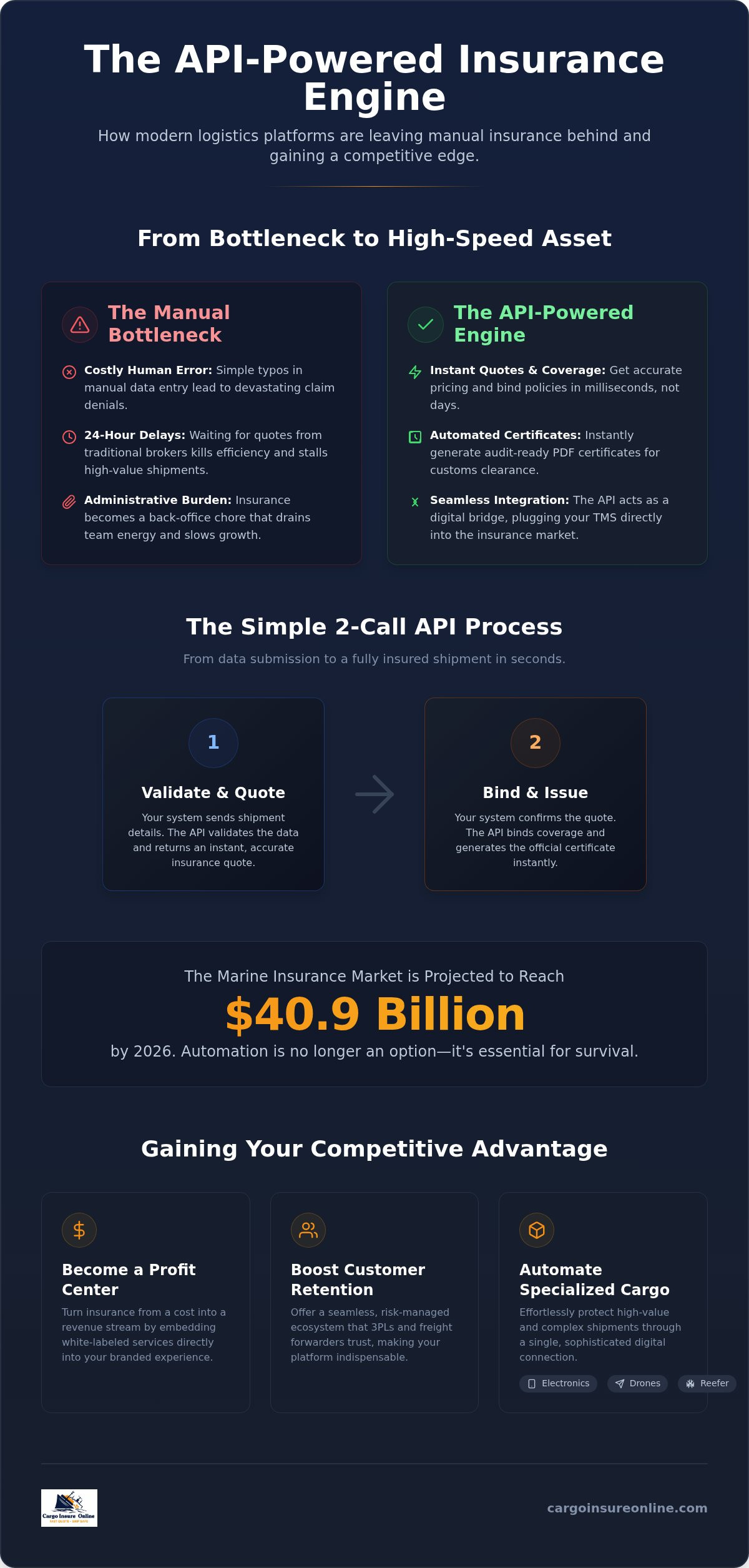
Traditional insurance is a relic. It is slow, bureaucratic, and buried under a mountain of paper that has no place in a modern warehouse. While your shipments move across the globe in hours, your insurance processes are often stuck in the last century. This friction is a direct threat to your logistics speed. Every second your team spends re-typing data into a broker's portal is a second lost to a more agile competitor. In a world of sub-second decisions, manual workflows are a tax on your growth.
Human error is the silent killer of your bottom line. A single typo on a certificate of insurance can lead to a devastating claim denial. You shouldn't have to gamble your cargo's safety on manual data entry or the focus of a tired employee. Modern logistics demands a level of precision and velocity that manual brokers simply cannot provide. If your insurance doesn't move as fast as your freight, it isn't protection; it's a liability.
The Cost of the 'Wait-and-See' Quote Model
In the high-stakes world of air freight, speed is the only metric that matters. If a high-value shipment is sitting on the tarmac while you wait 24 hours for a quote from a traditional broker, your efficiency is dead. Manual workflows make it impossible to scale for high-volume e-commerce where hundreds of shipments need coverage simultaneously. You can't hire enough people to keep up with that volume manually. In 2026, "instant" isn't a luxury; it's the only acceptable speed for survival. A delay in coverage is a delay in revenue, and your clients won't wait for your paperwork to catch up.
Moving from Administrative Chore to Automated Asset
It's time to stop viewing Cargo insurance as a back-office burden. By implementing cargo insurance API integration, you move protection from a hidden chore to a front-end feature that your clients can see and trust. This shift provides massive psychological relief for your operations team. They no longer have to "remember" to insure a load because the system handles it automatically.
This is the hallmark of a digital-first shipping partnership. You aren't just moving boxes; you're providing a seamless, risk-managed ecosystem. When your platform handles risk management through cargo insurance API integration, you become a sophisticated ally rather than just another service provider. You eliminate the friction of manual filing and replace it with the confidence of automated, real-time protection. The transition is simple: stop chasing brokers and start empowering your own platform.
What is a Cargo Insurance API? The Engine Behind Instant Coverage
An API isn't just a technical connection. It's a direct pipeline that plugs your shipping platform into a global underwriting engine. Think of it as a digital bridge between your Transport Management System (TMS) and the insurance market. This connection enables real-time data exchange. It eliminates the middleman while maintaining professional-grade protection. You no longer have to wait for a broker to wake up and check their email. The system does the heavy lifting for you.
By using cargo insurance API integration, you turn a complex financial product into a seamless software feature. This shift aligns perfectly with the 5 Trends Driving Supply Chain Modernization, where connectivity defines the winners of global trade. You gain the power to quote, bind, and issue coverage in one continuous stream. It’s about moving away from fragmented emails and toward a single, high-speed source of truth for every shipment you handle.
Quoting, Issuance, and Certificates in Milliseconds
Efficiency in 2026 relies on a smart "2-call" API structure. First, the system validates the shipment details to provide an instant, accurate quote. Second, it issues the coverage and generates a certificate immediately. This speed is critical for meeting strict Amazon FBA cargo insurance requirements where delays aren't tolerated. Instant PDF generation ensures your documentation is ready for customs clearance before the freight even moves. With cargo insurance API integration, your compliance is automated and your certificates are always audit-ready.
Automating Specialized Cargo: From Drones to Electronics
Generic APIs often stumble when cargo gets complicated. You can't protect a shipment of high-end drones with the same basic rules used for dry van freight. A sophisticated integration allows you to set specific parameters for high-value assets. This is where specialized electronics shipping insurance becomes a competitive advantage. You can automate rules for mobile phones, hardware, and even temperature-sensitive goods. By integrating real-time data for reefer cargo insurance, you ensure that every delicate variable is accounted for without manual intervention. Ready to see it in action? You can explore our white-label API solutions to see how easily these rules fit into your existing workflow.
Beyond Connectivity: The Competitive Edge of Embedded Insurance
Stop buying insurance. Start offering it. In the past, protection was a line-item expense you paid to a third party. Now, cargo insurance API integration lets you flip the script. You can transform a traditional cost center into a high-margin value-add for your own clients. By embedding coverage directly into your platform, you increase customer retention and build a deeper level of trust. You aren't just a 3PL or a forwarder anymore; you're a comprehensive risk management partner. This is about more than just moving boxes. It's about owning the entire transaction.
This strategic shift turns insurance from a hurdle into a profit engine. When you provide protection as a native feature, you eliminate the need for your clients to shop around. They get the safety they need. You get a stickier relationship and a new revenue stream. It is a win-win scenario powered by sophisticated connectivity. You are no longer just a link in the supply chain; you are the architect of a secure, digital-first ecosystem.
Branding the Experience with White Label Solutions
Your clients don't need to see our logo. They need to see yours. A branded cargo insurance platform ensures that the UI/UX remains consistent across your entire digital ecosystem. This is the hallmark of an open and connected insurance industry where technology fades into the background. You handle the customer relationship. We handle the risk. It is a seamless partnership that empowers your brand without the bureaucratic noise of a legacy insurer. You don't have to build an insurance company from scratch. You just have to plug into one.
Scaling E-Commerce Logistics Without the Friction
Manual insurance simply doesn't scale. If you're handling thousands of small-parcel shipments for Shopify or Amazon FBA, you can't stop for every box. Cargo insurance API integration is the only way to move at the speed of modern e-commerce. You can set automated rules that apply coverage based on value, destination, or product type. This bulk automation doesn't just save time; it reduces the per-shipment administrative cost. You get the protection you need without the friction that slows your growth. It's fast. It's precise. It's the only way to win in the high-volume digital marketplace.
Seamless Integration: Deploying Your Insurance Engine in Record Time
Integration doesn't have to be a headache. Forget the months-long development cycles and the frustration of legacy code. Modern cargo insurance API integration is about smart architecture and rapid deployment. You want to launch fast. You want to iterate. You want to dominate your niche before the competition even wakes up. By utilizing a sandbox environment, you can conduct rigorous testing without risking your live operations. It is about building a robust bridge between your data and our protection.
Mapping your shipment data is the core of the process. You take existing fields like weight, value, origin, and destination and connect them directly to insurance risk parameters. This isn't a complex rebuild; it's a strategic alignment. Once the fields are mapped, the system handles the rest. You get a frictionless workflow that scales with your ambition. Stop fearing the tech and start leveraging it to protect every load you move.
The 4-Step Integration Roadmap
Speed is the goal, and a clear path gets you there faster. Follow this streamlined roadmap to go from zero to fully protected:
- Step 1: API Key Acquisition and Documentation Review. Get your credentials and dive into our developer portal to understand the endpoints.
- Step 2: Environment Setup. Start in the sandbox. This is your safe space to break things, fix them, and perfect the logic before the production launch.
- Step 3: Field Mapping. Link your shipment data. Ensure value, weight, and geography flow correctly into the risk engine.
- Step 4: Live Testing and Automated Certificate Generation. Run real-world scenarios to confirm that certificates are issued in milliseconds.
Developer-First Documentation: Reducing Implementation Friction
Clean code is the backbone of a successful integration. We prioritize RESTful API structures because they are the gold standard for connectivity. A RESTful API is a standard architectural style that allows different software systems to communicate over the internet using standard HTTP methods. This simplicity means your developers spend less time troubleshooting and more time building value.
Automation doesn't stop at the quote. You can also handle the cargo insurance claim process through webhooks. These real-time notifications alert your system the moment a status changes, keeping your clients informed without manual updates. It is a sophisticated, "set-and-forget" solution for modern logistics. Ready to build your engine? Contact our technical team to access our documentation and start your journey today.
Cargo Insure Online: The High-Octane API for Modern Freight
CIO isn't just another name in a crowded market. We are your technology ally. We designed our platform to meet the aggressive demands of the 2026 supply chain. You get comprehensive All-Risk coverage for air freight insurance and sea freight without the typical legacy lag. We don't believe in generic protection. Instead, we use specialized algorithms to manage high-value devices and drones with surgical precision. It is global coverage delivered with local-level accuracy in every single quote.
Traditional insurance feels like a brake on your business. CIO feels like an accelerator. We focus on the high-speed movement of goods. We prioritize your time because we know that in global trade, time is currency. By choosing cargo insurance API integration with us, you aren't just checking a box. You are upgrading your entire logistics operation to a new standard of efficiency. You aren't just moving freight; you're moving at the speed of data.
Why Innovators Choose CIO Sphere Inc.
The world's most ambitious logistics platforms choose CIO Sphere Inc. because we share their digital-first DNA. Our parent company has built a reputation for stripping away the bureaucracy that has plagued this industry for decades. We replaced slow phone calls with instant data hooks. We swapped thick paper binders for clean, automated code. This isn't just a technical upgrade. It's a total reimagining of how risk is managed in a connected world.
Our support team is different. They are vibrant, high-energy specialists who understand both the cargo and the code. When you integrate with us, you get more than a documentation link. You get a partner that is invested in your success. We built this for the future of global supply chains. We built it to ensure your cargo insurance API integration is the strongest link in your tech stack. Confidence isn't a hope; it's a feature of our architecture.
Get Started: Your Branded Insurance Engine Awaits
Your journey to a frictionless platform starts here. You don't need a massive development team to get results. Our onboarding process is designed for speed. You can move from zero to fully integrated in a matter of days, not months. We've simplified the complexity so you can focus on scaling your business. The tools are ready. The documentation is clear. The only thing missing is your connection.
Your clients are waiting for a better experience. Give them the confidence of instant, branded protection under your own name. Don't let manual processes hold your growth hostage for another year. The future of logistics is connected, automated, and instant. Reach out to our technology team today to secure your API keys and unlock your sandbox environment. Stop waiting. Start integrating.
Own the Future of Protected Logistics
The days of chasing brokers and fixing manual typos are over. You've seen how the right cargo insurance API integration turns a slow administrative chore into a high-octane competitive edge. By automating your risk management, you don't just save time; you build a platform that's ready for the massive scale of 2026 global trade. It's time to stop letting paperwork dictate your shipping speed.
You deserve a partner that moves as fast as your freight. Whether you are protecting high-value drones or managing thousands of e-commerce parcels, the solution is at your fingertips. With specialized high-value tech coverage, instant all-risk quotes, and full white-label capabilities, you can provide a world-class insurance experience under your own brand. The technical barriers are gone. The roadmap is clear.
Launch your high-speed insurance engine with Cargo Insure Online today. Your platform is powerful. Now, make it bulletproof.
Frequently Asked Questions
Can a cargo insurance API handle high-value electronics and drones?
Yes, a sophisticated cargo insurance API integration is designed specifically for complex cargo. Generic policies often fail high-value tech, but our algorithms prioritize drones and mobile phones. You get precision-grade protection that understands the unique risks of high-end electronics. It is no longer about one-size-fits-all coverage; it is about specialized, data-driven protection for the digital age.
How long does it typically take to integrate the Cargo Insure Online API?
You can move from zero to fully integrated in a matter of days. We've stripped away the bureaucratic lag of traditional insurance setups. Our RESTful structure and clean documentation empower your developers to work fast. You don't have to wait for weeks of manual approval. Just plug in, test your fields in the sandbox, and start protecting your shipments immediately.
Is the API compatible with major TMS and e-commerce platforms?
Yes, our API is built for seamless compatibility with major Transport Management Systems and e-commerce platforms. Whether you're scaling on Shopify or managing high-volume Amazon FBA shipments, the integration is frictionless. We prioritize connectivity so you can automate your workflow without switching your existing tools. It is about making your current stack smarter, faster, and more secure for every user.
What is the difference between embedded insurance and traditional cargo insurance?
Traditional insurance is a slow, manual chore that requires external brokers and endless paperwork. Embedded insurance is a native feature of your own platform that operates automatically. With cargo insurance API integration, protection becomes a seamless part of the shipping transaction. You don't just buy a policy; you deploy a high-speed insurance engine that adds immediate value to your brand.
Can I white-label the insurance certificates to show my own company logo?
Yes, you have full control over the branding of your insurance engine. Our white-label solutions ensure that your clients see your logo on every certificate, not ours. This builds trust and keeps your UI/UX consistent throughout the entire shipping journey. You provide the professional-grade protection while we handle the risk in the background. It's your brand, powered by our sophisticated technology.
Does the API support instant claims filing or just quoting?
The API supports the entire insurance lifecycle, including instant claims filing. You aren't limited to just getting a quote or issuing a certificate. If something goes wrong, you can trigger the claims process directly through your platform using webhooks. This eliminates the need for manual emails and phone calls, providing a faster resolution and better experience for your clients.
Is there a sandbox environment for testing the API before going live?
Absolutely, we provide a dedicated sandbox environment for rigorous pre-launch testing. You can map your data fields and generate test certificates without any financial risk. This ensures your integration is bulletproof before you move to production. We want you to launch with total confidence, knowing every line of code is performing exactly as expected for your high-volume logistics.


