
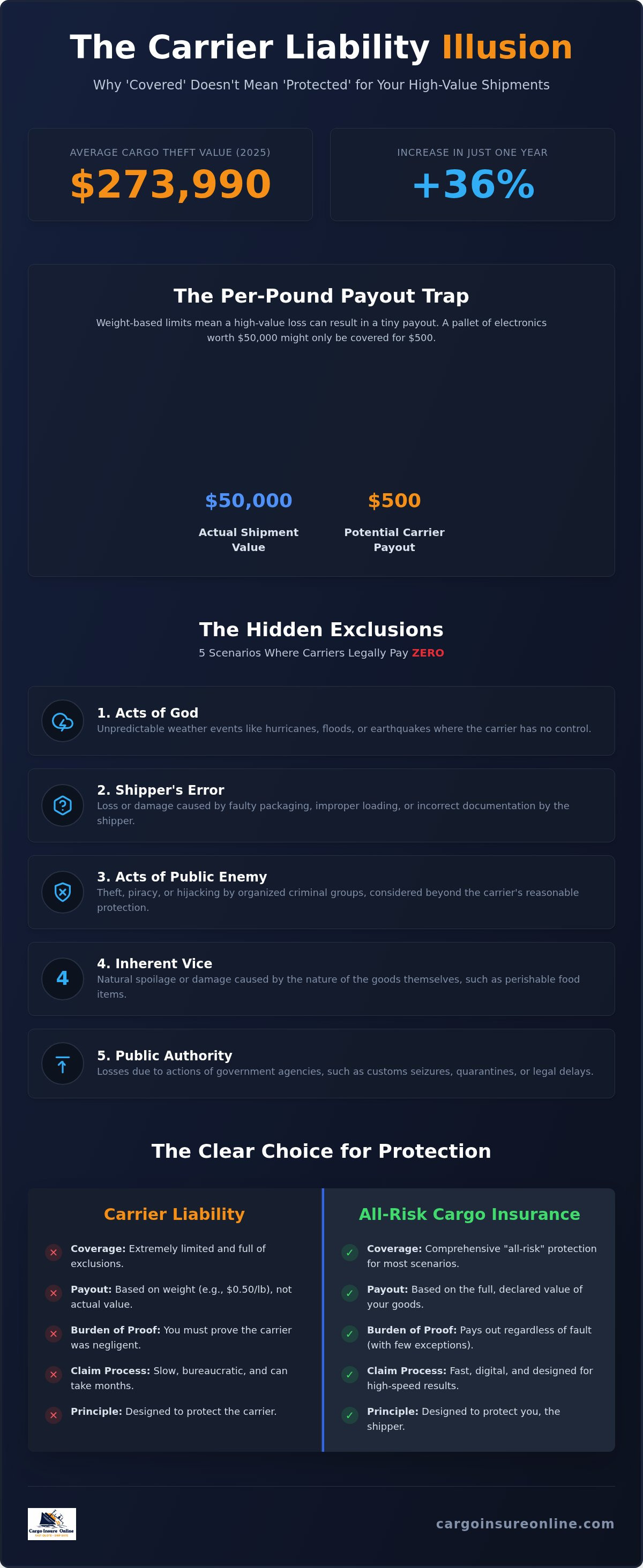
The average cargo theft in 2025 reached a record $273,990. That is a 36% increase in just one year. If you think your carrier's insurance will make you whole after a loss, you are likely mistaken. Most shippers realize too late that carrier liability is a legal floor, not a safety net. It is a system where "Acts of God" or weight-based limits can turn a major financial loss into a tiny payout. It's time to ask the hard question: what does carrier liability not cover?
You deserve better than months of paperwork and denied claims. You want complete financial protection for your high-value goods without the stress of proving carrier fault. This 2026 guide exposes the massive gaps in standard coverage and shows you how to bridge them with high-speed, all-risk protection. We will clarify exactly when a carrier is legally "off the hook" and how you can secure a frictionless, digital-first solution for your freight. Stop gambling with your cargo and start protecting your bottom line with total confidence.
Key Takeaways
- Understand why "covered" is a legal technicality that rarely equates to full financial protection for your high-value shipments.
- Identify the five critical scenarios, including weather events and packaging mistakes, to answer what does carrier liability not cover before your next load.
- Learn how weight-based payout limits can leave you with pennies on the dollar for expensive electronics and tech devices.
- Discover how to bypass the exhausting burden of proof with all-risk policies that pay out regardless of who is at fault.
- Shift to a digital-first claims process that replaces months of bureaucratic paperwork with high-speed, frictionless results.
The Carrier Liability Illusion: Why 'Covered' Doesn't Mean 'Protected'
Most shippers see the words "carrier liability" on a contract and feel a sense of security. It sounds like a safety net. It feels like a guarantee. In reality, it is a legal shield designed to protect the carrier, not your inventory. Carrier liability is a regulatory requirement that limits how much a trucking company or airline has to pay if things go wrong. It isn't a comprehensive insurance policy. It is a legal floor. Relying on it to protect high-value freight is the biggest gamble you can take in modern logistics.
The default setting for any loss is simple: the carrier is innocent until you prove them guilty. To recover even a fraction of your loss, you must navigate a complex freight claim process that often takes months. Even then, success isn't guaranteed. You aren't just fighting for your money; you are fighting against a legal system built to minimize carrier payouts. Understanding what does carrier liability not cover is the only way to move from a position of risk to a position of power.
The Legal Minimum vs. Total Protection
Liability only applies when the carrier has "Care, Custody, and Control" of your goods. If a loss occurs outside this narrow window, or if the carrier can point to a legal loophole, you get nothing. Standard terms are often so restrictive that they leave 90% of your shipment's actual value at risk. You aren't being paid for the replacement cost or the lost profit. You are being paid a tiny, pre-determined amount per pound. It is a system where a $50,000 pallet of electronics might only result in a $500 payout. This isn't protection; it is a financial disaster waiting to happen.
The 2026 Logistics Reality
The supply chain in 2026 is faster and more volatile than ever. Cargo theft is at an all-time high, and climate events are disrupting traditional routes with increasing frequency. In this environment, slow paperwork and bureaucratic claims are a death sentence for your cash flow. High-speed trade requires high-speed solutions. This is why air freight insurance has become non-negotiable for businesses moving tech and e-commerce goods. You don't have months to wait for a carrier to admit fault. You need digital-first protection that pays out based on the value of the goods, not the weight of the box. The shift from "covered" to "protected" is the ultimate competitive advantage.
The 'Hidden' Exclusions: 5 Scenarios Where Carriers Pay Zero
Think your cargo is safe because it's on a truck or a plane? Think again. The fine print in most carrier contracts contains "get-out-of-jail-free" clauses that leave shippers holding the bill. When you ask what does carrier liability not cover, the answer is often "the most common risks you face." Carriers aren't your insurance company. They are service providers with a specific legal list of reasons to say no to your claim. If your loss falls into one of these five categories, you are likely on your own.
- Acts of God: Unpredictable weather events like hurricanes or floods.
- Shipper's Error: Faulty packaging, loading, or documentation.
- Acts of Public Enemy: Theft, piracy, and modern hijacking.
- Inherent Vice: Natural spoilage or damage caused by the nature of the goods.
- Public Authority: Customs seizures, quarantine, or government delays.
Acts of God and Extreme Weather
A hurricane isn't just a storm; it's a legal exit strategy for carriers. If a flood or earthquake destroys your freight, the carrier will likely invoke "force majeure." This clause means they aren't responsible for events beyond their human control. Even in the air freight industry, where rules can feel stricter, the DOT Fly Rights guide highlights how airlines can limit their liability for cargo during weather disruptions. For temperature-sensitive goods, a storm-related power failure is a total nightmare. This is why smart shippers use reefer cargo insurance to protect their cold chain from the elements.
The 'Shipper's Fault' Trap
Carriers love to blame the person who packed the box. "Insufficient packaging" is the number one reason for denied claims in the logistics world. If your pallet shifts or a box collapses, the carrier will argue you didn't follow industry standards. In the world of road freight, improper loading is a frequent culprit in trucking cargo insurance disputes. One small documentation error can also void your entire claim. Don't let a typo cost you thousands. You can get a quote in seconds for all-risk protection that covers you even when the carrier points the finger back at you.
Finally, consider the modern threat of "Public Enemy" actions. In 2025, cargo theft losses in the U.S. and Canada hit a record $725 million. This was a massive 60% increase from the previous year. California alone accounted for 38% of all U.S. cargo theft incidents. If a sophisticated cyber-attack or a "Trojan Driver" steals your load, the carrier may argue they weren't negligent, leaving you with zero recovery. Between theft risks and "Inherent Vice", where goods like fruit or chemicals degrade naturally, the gaps are too wide to ignore. Digital-first all-risk insurance is the only way to close them.
The Per-Pound Payout Trap: Calculating the Real Financial Gap
Your cargo is gone. You expect a check for its value. You get a check for its weight instead. This is the "Per-Pound Payout Trap," and it's where most modern businesses lose their shirts. While you're calculating the retail value of your inventory, the carrier is looking at a scale. They don't care if the box contains gold bars or gravel. To them, it's just weight. This weight-based math is a primary reason why asking what does carrier liability not cover is so critical for tech-heavy shippers.
The legal foundation for these limits sits within the U.S. Code on carrier liability, which allows carriers to restrict their financial exposure through tariffs and bills of lading. If you aren't looking at the specific liability limits in your contract, you're essentially self-insuring 90% of your shipment's value. In a world of increasing supply chain volatility, that's a gamble you can't afford to take. You need a solution that recognizes the value of your goods, not just their mass.
Weight vs. Value: The Math of Loss
In the world of Less-than-Truckload (LTL) shipping, liability limits typically range from $0.10 to $2.00 per pound. This works fine if you're shipping raw steel or bulk lumber. It's a disaster if you're shipping high-value electronics or medical devices. A 10lb drone worth $5,000 might only net you a $20 liability payout because the carrier only sees ten pounds of plastic and wire. The "Electronics Nightmare" is real; losing a $2,000 laptop and getting a $10 check is a standard outcome under carrier liability rules.
The situation is even more brutal on the water. Ocean carriers often limit their liability to $500 per "customary freight unit," which could be an entire pallet or even a whole container. This is why sea freight insurance is vital for heavy but expensive machinery. Without it, a total loss at sea could bankrupt a small business relying on carrier liability alone. Don't let a carrier's scale decide the fate of your company's cash flow.
The Used Goods Penalty
If you're shipping refurbished or used items, the trap gets even deeper. Most carriers won't pay full value for anything that isn't brand new. They use "Actual Cash Value" (ACV), which factors in depreciation. You might have paid $1,000 for a refurbished server, but the carrier will argue it's only worth $100 based on its age and wear. This "replacement cost" gap is a major pain point for the circular economy and secondary markets.
This is precisely why cross-border e-commerce insurance is so important for modern sellers. You need protection that covers the actual cost to replace the item and ship it back to the customer, not a fraction of its depreciated weight. Switching to a value-based, all-risk policy ensures that your payout matches your actual financial loss. Stop weighing your risks and start protecting your value.
The Burden of Proof: Why Proving Carrier Fault is a Losing Battle
Knowing the carrier broke your freight is one thing. Proving it in a court of law is another. Under standard liability, the burden of proof rests squarely on your shoulders. You have to demonstrate that the goods were in good condition at pickup and damaged at delivery. Even then, carriers are masters of the rebuttal. They will blame the road, the packaging, or even the weather to avoid a payout. This legal chess match is exactly what does carrier liability not cover: your peace of mind and your time.
The system is built on friction. Carriers often take 90 days or more just to process an initial claim. By the time they tell you "No," your cash flow has already taken a hit. This "fault" requirement turns every incident into an investigation. It slows down your supply chain and creates unnecessary tension with your logistics partners. You shouldn't have to play detective to get reimbursed for a loss.
The Clean Receipt Problem
Signing a delivery receipt is a high-stakes moment. If your warehouse team signs it without noting damage, your claim is effectively dead on arrival. This is the "Clean Receipt" trap. Carriers use that signature as absolute proof that they fulfilled their duty. If you discover broken items inside the boxes later, you are dealing with concealed damage. You generally have a 15-day window to report this, but carriers deny these claims at a staggering rate. They will argue the damage happened in your warehouse, not their truck. In 2026, digital proof and instant photo uploads are helping, but they don't change the underlying legal hurdle of proving carrier negligence.
The Administrative Drain
The real cost of a claim isn't just the lost inventory. It's the dozens of hours your staff spends on the phone with carrier legal departments. Your team should be focused on growth, not fighting bureaucratic battles. A carrier's internal investigation is rarely a neutral search for truth. It is a process designed to find a reason to deny liability, which is a major part of what does carrier liability not cover in a real-world scenario. This is why modern shippers are moving away from the "prove fault" model. You can switch to all-risk protection and get paid regardless of who is to blame. Stop fighting the system and start using technology to bypass it entirely.
Beyond Liability: Switching to Digital-First All-Risk Protection
Carrier liability is a legal relic. It belongs to an era when logistics moved at a snail's pace and paperwork was the only way to track a pallet. In 2026, your business demands more than a legal minimum. It requires a digital-first upgrade that actually protects your bottom line. The most important answer to what does carrier liability not cover is certainty. All-risk coverage removes the "if" from your financial recovery. It doesn't matter if a storm hits or a driver makes a mistake. You get paid based on the full value of your goods, not a per-pound legal limit that leaves you short. This isn't just insurance. It is a strategic tool for growth.
Cargo Insure Online replaces bureaucratic delays with high-speed automation. We've built a platform specifically for high-value tech and e-commerce leaders. While traditional carriers struggle with "high-risk" items, we offer specialized protection for drones, mobile phones, and sophisticated electronics. We don't just sell policies; we deliver a frictionless claims experience. Every minute your capital is tied up in a carrier investigation is a minute you aren't growing. Our all-risk policies ensure you have the liquidity to re-order stock and maintain customer trust immediately after a loss.
The CIO Difference: Speed and Clarity
Traditional insurance brokers take days to return a quote. We provide them in seconds. Our digital-first approach offers instant quotes that match the velocity of global trade. We also provide white-label solutions for brokers who want to protect their clients with the same high-speed efficiency. For modern e-commerce brands, all-risk is the only logical choice. You shouldn't have to hire a legal team to interpret your coverage. Our platform provides total clarity and removes the administrative drain that usually follows a freight claim. We've stripped away the friction so you can focus on scaling your business.
Your Next Step: Stop Guessing, Start Insuring
You now know the massive financial risks hidden in standard shipping contracts. You understand exactly what does carrier liability not cover, from "Acts of God" to the weight-based payout traps that can bankrupt a shipment. Bridging this gap is the only way to protect your inventory in a volatile world. A single lost shipment should never derail your entire quarter. Stop gambling with your assets and start using a platform built for the modern logistics landscape. Experience a zero-friction shipping journey where your high-value freight is always protected at its true value.
Get an instant all-risk quote from Cargo Insure Online today!
Take Command of Your Logistics Future
Waiting for a carrier to admit fault is a relic of the past. You've seen the data. You know that weight-based payouts and "Acts of God" loopholes are designed to protect the carrier, not your bottom line. Relying on the legal minimum is no longer a viable strategy in a high-speed, high-value economy. When you understand exactly what does carrier liability not cover, the choice becomes clear. You need a partner that matches your velocity and values your inventory as much as you do.
Cargo Insure Online delivers 2026 tech-ready coverage with zero-friction digital claims. We are specialists in high-value electronics, ensuring your drones and smartphones are protected at their true replacement value, not their weight. Stop the paperwork cycle and start growing with total financial certainty. It's time to bridge the gap with a sophisticated, digital-first ally that prioritizes your time. Take the friction out of your supply chain and enjoy the relief of total protection today.
Secure Your Freight with Instant All-Risk Coverage
Your cargo is too valuable to leave to chance. Move forward with the confidence that your business is shielded from the unpredictable. We are ready to help you scale without the risk.
Frequently Asked Questions
What is the difference between carrier liability and cargo insurance?
Carrier liability is a legal minimum that only pays out if you can prove the carrier was negligent. It is a shield for the transport company, not a safety net for you. Cargo insurance is an all-risk policy that pays the full value of your goods regardless of who is at fault. It replaces bureaucratic finger-pointing with guaranteed financial recovery and high-speed results.
Does carrier liability cover theft or hijacking?
Rarely. Carriers often classify theft or hijacking as "Acts of Public Enemy" or criminal acts beyond their control. Unless you can prove the carrier left the truck unlocked or was otherwise negligent, they aren't liable. This is a massive gap in what does carrier liability not cover, especially with cargo theft incidents hitting record highs in 2025. All-risk protection is the only way to stay covered against modern hijacking risks.
Why is my carrier liability payout so much lower than my item's value?
Carriers pay by the pound, not by the invoice. Standard liability limits often range from $0.10 to $2.00 per pound for LTL shipments. If you ship a five-pound box of high-value electronics worth $5,000, a carrier might only owe you $10. They use a scale to determine your payout while you use your bank account. All-risk insurance bridges this gap by covering the actual replacement cost.
What are 'Acts of God' in shipping and why aren't they covered?
Acts of God are natural disasters like hurricanes, floods, or earthquakes that no human can prevent. Carriers aren't legally responsible for these events because they fall under "force majeure" clauses. If a storm destroys your freight, the carrier is legally off the hook. This is a primary exclusion in what does carrier liability not cover. All-risk policies ignore these loopholes and pay out even when nature strikes.
How long do I have to file a claim against a carrier for damaged freight?
You generally have nine months to file a formal claim, but the real deadline is much shorter. You must note any visible damage on the delivery receipt immediately. If you sign it "clean," the carrier will argue the damage happened after they left. Don't let the nine-month window fool you. The first five minutes at the loading dock are the most critical for your recovery.
Does carrier liability cover 'concealed damage' found after delivery?
Winning a concealed damage claim is nearly impossible. You typically have 15 days to report damage found after a "clean" delivery, but the burden of proof is exhausting. The carrier will almost always argue that the damage occurred in your warehouse. Without all-risk insurance, you are left fighting a losing battle against a carrier's legal department. Digital proof helps, but it rarely overcomes a clean signature.
Is cargo insurance worth it if the carrier already has liability coverage?
Yes, because liability coverage is designed to fail when you need it most. It is a legal floor filled with exclusions like weather, theft, and packaging errors. Relying on it is a gamble with your company's cash flow. Cargo insurance turns a potential total loss into a minor speed bump. It's a strategic investment that provides the peace of mind that a carrier's legal minimum never will.
Can I buy all-risk insurance for international air freight shipments?
Absolutely. You can secure all-risk protection for air, sea, and land shipments across the globe in seconds. International trade moves fast, and your insurance should keep pace. Digital-first policies provide specialized coverage for high-value tech and e-commerce goods moving through global hubs. You don't have to settle for the narrow limits of international conventions when you can have total, high-speed protection for every mile.


