
What if your insurance process moved faster than the freight you are shipping? For most, it is the opposite. You are likely tired of waiting days for a single quote while manual entry errors eat your time. It's a slow, margin-killing grind that keeps your team buried in paperwork. You know the frustration of watching a deal stall because the insurance desk is still checking the files.
It is time to stop. The right cargo insurance software for freight forwarders transforms this administrative drag into a high-speed revenue engine. This isn't just about digitizing a form; it's about embedding profit directly into your daily workflow. We promise to show you how to flip the script on low margins and complicated claims using modern automation.
In this guide, we explore the 2026 digital standard for global logistics. You will learn how instant API integration and white-label branding turn a back-office chore into a massive competitive edge. We are moving from the era of "we will get back to you" to the age of "it is already done." Let’s dive into the tech that makes it possible.
Key Takeaways
- Stop wasting hours on manual paperwork. Learn how instant quoting turns a slow process into a high-speed revenue engine.
- Bridge the gap between carrier liability and total protection. See why all-risk coverage is non-negotiable for high-value electronics and reefer shipments.
- Scale faster with API-driven connectivity. Find out how the best cargo insurance software for freight forwarders embeds protection directly into your existing TMS.
- Own the client experience. Discover how white-label solutions transform insurance from a back-office chore into a branded, professional service.
- Boost your bottom line. Learn to identify real-time coverage gaps and capture higher margins on every single shipment.
Why Traditional Cargo Insurance is Killing Your Forwarding Margins
Traditional insurance is an anchor. It is heavy, slow, and outdated. While your freight moves at the speed of sound, your insurance procurement often moves at the speed of a fax machine. Every minute spent waiting for a broker's email is a minute your margins shrink. This isn't just an inconvenience; it is a strategic failure that stalls your growth.
Manual quoting is the silent killer of profitability. You are paying skilled operators to copy and paste data into fragmented spreadsheets. One typo in a commodity description can invalidate a claim months later. It is a high-stakes game played with low-tech tools. Modern Marine Insurance has evolved, but many forwarders are still stuck in the 1990s. Stop waiting for bureaucracy to catch up. Start automating.
The Friction Problem in Logistics
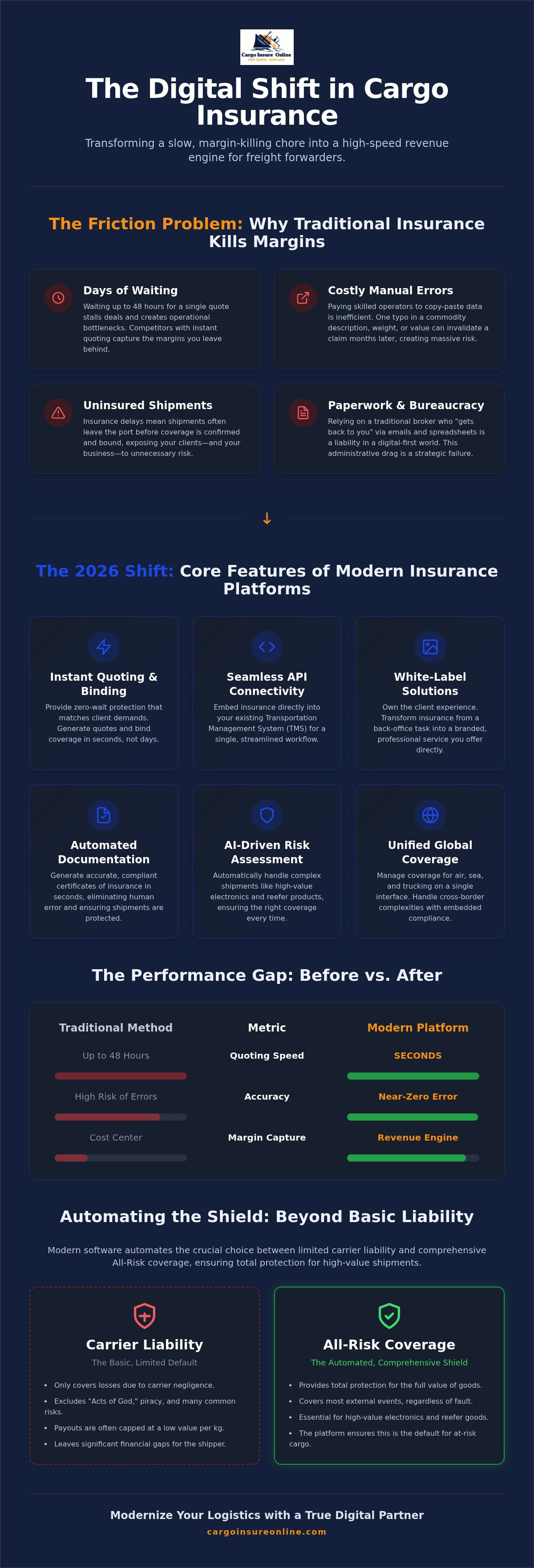
Administrative lag is the enemy of efficiency. When you are managing tight windows for air or sea freight, you don't have forty-eight hours to wait for a quote. This delay creates a bottleneck that ripples through your entire operation. Clients want answers now. If you can't provide them, they will find someone who can. The friction of manual data entry doesn't just slow you down; it creates risk.
- Data entry errors: Small mistakes in weight or value can lead to rejected claims.
- Missed windows: Shipments often leave the port before coverage is even bound.
- Lost revenue: Competitors with embedded insurance are capturing the margins you're leaving on the table.
Forwarders are losing significant revenue to tech-first competitors who offer protection in a single click. If your insurance process feels like a chore, you are doing it wrong.
The 2026 Shift: From Policies to Platforms
The old way is dead. Relying on a traditional broker who "gets back to you" is a liability in a digital-first world. The 2026 digital engine requires a platform, not a person with a clipboard. You need cargo insurance software for freight forwarders that acts as a proactive partner in your workflow.
This shift isn't about replacing the intermediary; it is about upgrading them. Digital-first providers like Cargo Insure Online (CIO) offer the infrastructure to turn insurance into a value-added service. By redefining insurance as a platform, you transform it from a back-office expense into a front-end revenue generator. No more paperwork. No more waiting. Just instant protection and higher margins. The transition to software-driven logistics isn't coming; it is already here. Are you driving the engine or trailing behind?
Core Features of Modern Cargo Insurance Software
Forget the phone calls. Trash the manual spreadsheets. Modern cargo insurance software for freight forwarders isn't just a tool; it's a command center. It replaces the old, slow ways of working with a high-octane digital engine. You get instant quoting and binding. There is no more waiting for a broker to wake up or check their inbox. You provide zero-wait protection that matches the speed of your clients' demands.
The best platforms offer more than just speed. They provide automated documentation that generates certificates in seconds, not hours. This precision ensures that your shipments are always compliant and protected before they leave the warehouse. While the basics of What Is Cargo Insurance remain the same, the delivery mechanism has changed forever. You gain a real-time dashboard that monitors every shipment and manages claims through a single, clear interface. It’s fast. It’s accurate. It’s the new standard.
Automation and Intelligence
No more guessing games. Modern software uses AI-driven risk assessment to handle complex shipments like high-value electronics and reefer products. The system automatically navigates the "All-Risk" versus "Named Perils" decision tree for you. It ensures your clients get the right coverage every time. By synchronizing data directly from your shipment records, the software eliminates human error and keeps your claims valid. You can start leveraging a digital intermediary to handle these technical hurdles automatically.
Global Connectivity
Your business doesn't stop at the border, and neither should your tech. Modern platforms offer seamless coverage for air, sea, and trucking on a single interface. They handle cross-border complexities by embedding regulatory compliance into the workflow. This precision is vital when handling specialized risks like electronics shipping insurance, where values are high and margins for error are zero. Whether you are moving drones or mobile phones, the software ensures global protection is always a click away. It connects your operations to the global market without the traditional administrative headache.
Carrier Liability vs. All-Risk Software: Automating the Shield
Carrier liability is a gamble you can't afford to take. It is an outdated system designed to protect the carrier, not your client’s bottom line. Many forwarders mistakenly believe that standard international conventions provide a sufficient safety net. They don't. In reality, these rules are tissue-paper thin, offering only a fraction of the actual cargo value in the event of a loss. Stop crossing your fingers and start closing the gaps.
The financial risk of relying on standard limits is massive. If a shipment is damaged, you are often stuck in a legalistic nightmare, trying to explain to a client why they are only receiving pennies on the dollar. This doesn't just hurt your wallet; it kills your reputation. Modern cargo insurance software for freight forwarders changes this dynamic by automating the transition from basic liability to comprehensive "All-Risk" peace of mind.
Decoding the Per-Kilo Rule
Weight does not equal value. This is the fundamental flaw of the "Per-Kilo" rule. For forwarders moving high-value electronics or specialized tech, this rule is a financial trap. If a pallet of drones worth $50,000 is crushed, but it only weighs 100 kilograms, the carrier’s payout might not even cover the shipping costs, let alone the product loss. You can find more detail on these complexities in A Forwarder's Guide to the Sea Freight Damage and Claim Process.
- The "High-Value" Exposure: Lightweight tech often carries the highest risk and the lowest carrier protection.
- The Reputational Hit: Clients don't care about "SDRs" or "Warsaw Conventions"; they care about their lost inventory.
- The Legal Stall: Proving carrier negligence is a slow, expensive process that software helps you avoid entirely.
The "Per-Kilo" rule limits carrier compensation to a fixed monetary amount based on weight, often leaving forwarders responsible for massive financial shortfalls when shipping lightweight, high-value cargo.
The Software Solution to Liability Gaps
Don't leave your protection to chance. Digital platforms act as an intelligent shield, identifying coverage gaps the moment you enter shipment data. When the software detects that carrier limits are insufficient, it can trigger automated GAP insurance or suggest an upgrade to full "All-Risk" coverage. This ensures 100% invoice value protection without any manual intervention.
Compare the difference between standard limits and specialized air freight insurance. While carriers cap their exposure, your software expands your protection. It creates a "Single Source of Truth" that matches the insurance bound to the actual value of the goods. You move from being a middleman to a protector. It’s fast, it’s automated, and it’s the only way to scale safely in 2026.
How to Integrate Digital Insurance into Your Logistics Workflow
Integration isn't a months-long IT project. It is a strategic pivot. Modern cargo insurance software for freight forwarders embeds directly into your existing TMS or ERP. No more jumping between tabs. No more re-typing container numbers. By establishing a "Single Source of Truth," you ensure that every piece of shipment data is captured once and used everywhere. This eliminates the "human factor" that leads to missed coverage or rejected claims. It makes your operation leaner and your protection stronger.
Whether you're managing complex Sea freight or localized trucking cargo insurance, the platform scales with you. It transforms your operations team into a high-performance sales force. They aren't just moving boxes; they are providing total peace of mind. Protection becomes a default, not an after-thought. When your team can offer a quote in seconds, insurance becomes a powerful sales tool that boosts your margins on every booking.
The Power of API Connectivity
API integration is the bridge between logistics and insurance. It allows data to flow at the speed of light. Forget the days of waiting for a broker to return from lunch. Your TMS sends the data; the underwriting engine returns a quote in seconds. This creates a frictionless booking experience for your clients. They get a price, they get a certificate, and they get moving. It's simple, it's fast, and it's built for the 2026 digital standard.
Customizing the Experience
Every route is different. Your software should know that. You can set specific rules-based triggers for sensitive cargo. If you're managing cold chains, the system can automatically apply reefer cargo insurance for high-value tech. For high-volume traders, you can embed cross-border e-commerce insurance into every checkout. You define the risk; the software provides the shield. Stop doing the manual work and let the platform drive your growth.
Ready to upgrade your workflow? Integrate your logistics engine with CIO now.
Scale Your Forwarding Business with White Label Solutions
Stop viewing insurance as a pass-through cost. It is a revenue engine waiting to be ignited. Most forwarders hand off their clients to third-party brokers the moment a shipment needs protection. They lose control. They lose data. They lose margins. The 2026 digital engine allows you to flip that script. By using a white-label solution, you transform a traditionally dry administrative chore into a high-margin, branded service that lives entirely within your ecosystem.
Professionalism is built on trust and visibility. When your clients access a portal that carries your logo and your colors, you aren't just a box mover anymore. You are a sophisticated digital logistics leader. This level of integration used to require millions in R&D. Now, the right cargo insurance software for freight forwarders delivers this capability out of the box. You get the technical sophistication of a global insurer with the personal touch of your own brand. It is fast, it is seamless, and it is yours.
Building Your Own Insurance Brand
Ownership is the ultimate competitive advantage. A white-label interface ensures you maintain the customer relationship from quote to claim. You don't have to send your clients to a competitor's site or a clunky third-party form. Instead, you offer a branded cargo insurance platform that feels like a natural extension of your services. This removes the "middleman" feel and reinforces your authority in global trade.
- Total Brand Consistency: Your logo, your fonts, and your unique user journey.
- Client Retention: Keep users on your platform longer by providing all-in-one protection.
- Technical Sophistication: Leverage Cargo Insure Online’s high-speed underwriting engine under your own name.
Next Steps: From Forwarder to Digital Logistics Leader
The roadmap to implementation is shorter than you think. You don't need a team of developers to launch your own insurance engine. You need a partner that understands the friction of global logistics and provides the tools to erase it. Measuring the ROI of automated insurance software is simple. Look at the hours saved on manual entry and the immediate boost in profit margins from embedded services.
Waiting is no longer an option. The industry is moving toward a digital-first standard where speed is the only currency that matters. Join the disruption. Stop managing paperwork and start scaling your business with a platform built for the future of freight. The engine is running. It's time to get behind the wheel.
Drive Your Digital Transformation Today
The era of manual paperwork and administrative drag is officially over. You've seen how the right cargo insurance software for freight forwarders turns a back-office chore into a high-speed revenue engine. By moving beyond the "per-kilo" trap of carrier liability and embracing automated all-risk protection, you safeguard both your shipments and your professional reputation. Whether you are moving high-value electronics, specialized drones, or temperature-sensitive reefer goods, the 2026 standard demands absolute speed and digital precision. You no longer have to choose between efficiency and security.
It is time to stop reacting to logistics friction and start leading the disruption. You can scale your business with a platform that is API-ready and built for the complexities of global trade. Don't wait for the rest of the industry to catch up while your margins dwindle under the weight of outdated processes. Launch Your Branded Insurance Engine with Cargo Insure Online to unlock instant quotes and binding, specialized tech coverage, and seamless white-label integration. The future of forwarding is digital, automated, and ready for you to take the lead today.
Frequently Asked Questions
What is cargo insurance software and how does it work for forwarders?
Cargo insurance software is a digital platform that automates the procurement and management of shipment protection. It works by replacing manual emails and spreadsheets with a direct, cloud-based interface. Forwarders enter shipment details or sync them via API to receive instant quotes. It is the modern alternative to the slow, bureaucratic nature of traditional insurance. This cargo insurance software for freight forwarders ensures your operations move at the speed of 2026.
How does cargo insurance software differ from traditional brokerage?
Traditional brokerage relies on manual negotiation and slow communication. Software prioritizes instant data processing and immediate results. You don't have to wait for a broker to return an email or check a physical file. Digital platforms provide quote and bind capabilities in seconds. It replaces the old culture of delay with a new standard of efficiency. It's about giving you control over your insurance timeline instead of being at someone else's mercy.
Can I integrate cargo insurance software into my existing TMS?
Yes, you can integrate this technology directly into your current workflow. High-performance cargo insurance software for freight forwarders uses API connectivity to bridge the gap between your TMS and the insurance market. This means you don't have to leave your primary operating system to secure a quote. It pulls data automatically to eliminate manual entry errors. It’s about building a seamless, frictionless booking experience for your entire team.
What is a white-label cargo insurance solution?
A white-label solution is a branded portal that carries your logo and company identity. It allows you to offer sophisticated insurance services without building the technology from scratch. You maintain the customer relationship while leveraging a high-speed underwriting engine. It removes the "middleman" feel from your business and positions you as a digital leader. It's the easiest way to transform a standard service into a professional, revenue-generating brand.
Is cargo insurance software suitable for high-value electronics or drones?
Yes, it is specifically designed to handle these high-stakes categories. The software uses intelligent risk assessment to provide all-risk coverage for high-value electronics, drones, and mobile phones. You don't have to worry about the "per-kilo" trap of carrier liability. The platform identifies the specific needs of tech shipments and applies the right protection instantly. It's the most reliable way to protect high-value inventory in a fast-moving market.
How does the digital claim process work with cargo insurance software?
The digital claim process is built for speed and transparency. You submit all necessary documentation through a centralized portal instead of dealing with endless email chains. Because the initial booking data is already in the system, the verification process happens much faster. You can track the status of your claim in real-time from your dashboard. It replaces the traditional "black hole" of insurance with a clear, manageable digital workflow.
What are the benefits of using an API for cargo insurance?
Using an API allows for instantaneous data exchange between your logistics systems and the insurance provider. It removes the need for manual data entry, which is where most errors occur. You can embed insurance directly into your booking process, making it a natural part of every shipment. This connectivity ensures that your protection scales automatically as your business grows. It’s the ultimate tool for creating a frictionless, high-speed logistics operation.
Does cargo insurance software cover sea, air, and trucking freight?
Yes, it provides total coverage across all major transport modes. You can manage sea, air, and trucking insurance through a single, unified dashboard. The software handles the unique regulatory and risk profiles of each mode automatically. Whether you are moving containers across the ocean or pallets across the country, the protection remains consistent. It offers a global shield for your entire logistics portfolio without requiring multiple different providers.


