
What if every shipment you booked automatically generated its own profit margin and protection without a single extra click? You already know the drill. You're managing data, risk, and cost at a breakneck pace, yet manually toggling between tabs to secure coverage remains a massive bottleneck. Relying on outdated methods instead of a freight forwarder ERP insurance integration is a relic of the past that’s costing you more than just time. In a 2026 landscape where cargo theft averages 6.4 incidents every single day, leaving protection to manual data entry isn't just slow; it's a liability you can't afford.
The solution isn't working harder. It's working smarter. You can transform insurance from a tedious administrative chore into a seamless, high-speed revenue engine directly within your existing software. You don't have to choose between speed and security anymore. You can have both, instantly, by automating your risk management at the point of sale. No more wasted hours. No more human error.
This article reveals how to embed protection directly into your digital booking workflow. We’ll dive into how you can secure instant quotes, eliminate coverage gaps, and unlock a new commission-based revenue stream with zero extra effort. Stop waiting and start shipping with total confidence.
Key Takeaways
- Eliminate the administrative bottleneck by transforming a 20-minute manual task into a 2-second background process.
- See why a freight forwarder ERP insurance integration is the key to removing "double entry" and drastically reducing human error across your operations.
- Unlock instant quoting engines and automated certificate generation to provide real-time protection at the point of sale.
- Turn insurance into an effortless profit center with white-label solutions that put your brand front and center.
- Master the four-step transition to a digital-first insurance model that automates your risk and scales your revenue.
The Manual Insurance Trap: Why Your ERP Needs an Upgrade
Manual workflows are a relic. They belong in the age of fax machines, not the digital-first reality of 2026. If your team is still copy-pasting shipment details from an ERP into an insurance portal, you aren't just wasting time. You're leaking profit through every crack in your process. Modern logistics moves at the speed of light, but manual insurance acts like a lead weight on your operations.
The role of a What is a Freight Forwarder? has evolved. You're now a manager of complex data and high-stakes risk. To thrive, a freight forwarder ERP insurance integration is no longer optional. It's the essential bridge between your operations and your bottom line. This integration creates a seamless connection between your logistics software and your insurance carrier, turning a friction-heavy chore into a competitive advantage.
The Friction Problem in Traditional Logistics
Traditional cargo insurance is fundamentally broken. You book a shipment. You wait for a quote. You wait some more. Often, the shipment is ready to move before the paperwork is even started. This delay creates massive data silos and leaves your business exposed to liability risks that shouldn't exist. When your systems don't talk to each other, you're essentially flying blind.
Disconnected systems are dangerous. When your insurance doesn't talk to your ERP, human error becomes a statistical certainty. A single typo in a commodity description or a missed decimal point in a shipment value can lead to devastating coverage gaps. In a year where cargo theft incidents in the U.S. average 6.4 per day, you can't afford a single mistake. Manual entry is the silent killer of your scalability.
What is Embedded Insurance Integration?
Embedded insurance is the high-tech antidote to administrative fatigue. It utilizes a direct API connection to link your ERP, such as CargoWise, Magaya, or Microsoft Dynamics 365, to a digital insurance provider. Instead of managing two separate tasks, you have one unified, intelligent workflow that lives inside your existing dashboard.
The data flows instantly. As soon as you input the weight, value, and destination into your system, the information transmits to the insurer in milliseconds. This is the ultimate "set it and forget it" solution for modern logistics. You get the protection you need without the headache of manual filing.
- Zero Double Entry: Data syncs automatically across all platforms without manual intervention.
- Instant Quotes: Real-time rates appear in your dashboard without leaving the screen.
- Immediate Coverage: Policies are issued and certificates are attached to the shipment record instantly.
This is the death of the manual bottleneck. By adopting a freight forwarder ERP insurance integration, you reclaim your time and protect your cargo before it even hits the road. Stop waiting for quotes and start scaling your revenue with confidence.
Manual vs. Integrated Workflows: A Performance Comparison
Stop burning billable hours on administrative friction. The gap between manual processes and a modern freight forwarder ERP insurance integration is the difference between a bicycle and a jet engine. One keeps you grounded in paperwork; the other propels your business forward. In 2026, efficiency isn't just a goal. It's a survival requirement. If your team is still toggling between browser tabs to secure cargo, you're already behind the curve.
The Speed Advantage
Manual quoting is a marathon of emails and phone calls. You send a request. You wait. Your customer waits. By the time you get a rate, the shipment might already be delayed. Integrated workflows flip the script entirely. What was once a 20-minute manual task becomes a 2-second background process. API-driven rates appear instantly in your dashboard. This allows you to provide "one-click" insurance at the exact moment of booking. This speed doesn't just save time. It spikes your conversion rates. When you offer immediate protection, you remove the hesitation that often kills a deal.
Data Integrity and Risk Mitigation
Human error is the silent profit-killer in global logistics. Manual "double entry" is a breeding ground for typos, missed decimal points, and incorrect commodity codes. By automating the data flow, you can reduce human error by up to 99%. The system pulls shipment values and descriptions directly from your ERP, ensuring every policy is accurate without a second look. This level of precision is mandatory for specialized cargo. If you are handling electronics shipping insurance, accuracy is your best defense. High-value tech requires exact documentation to satisfy carrier liability gaps. Automation ensures you never miss a requirement. It eliminates the "forgotten policy" risk that leaves forwarders exposed to massive claims.
Scaling is about efficiency, not headcount. Traditional growth usually requires hiring more clerks to manage the extra paperwork. With an integrated system, your existing administrative staff can handle 10x the shipment volume without breaking a sweat. The software does the heavy lifting while your team focuses on high-value strategy. Shippers benefit from this transparency immediately. They see their coverage status and policy details instantly on their tracking portal. This builds massive trust and slashes the number of status inquiries hitting your inbox. If you want to see how this works in real-time, you can explore our digital-first solutions today. Stop hiring for admin and start automating for growth.
Core Features of a High-Performance Insurance API
A high-performance API is more than just code. It's the nervous system of your digital logistics operation. When you implement a freight forwarder ERP insurance integration, you aren't just connecting two databases. You're building a high-speed highway for risk and revenue. This isn't about simple data transfer; it's about intelligent, real-time execution that keeps your shipments moving. It's about turning a passive record into an active asset.
The core of this system is the Instant Quoting Engine. It doesn't rely on static tables or outdated spreadsheets. It pulls live market data to provide accurate rates for air, sea, and trucking modes in milliseconds. Once a shipment is booked, the Automated Certificate Generation takes over. Forget manual PDF creation. The system generates the policy and attaches it directly to the shipment record in your ERP. It's there before you can even refresh the page. Recovery is just as fast. With Claims Portal Integration, you can start the recovery process without ever leaving your primary dashboard. No separate logins. No lost emails. Just a direct line to resolution.
Seamless Connectivity Requirements
Your IT team shouldn't have to spend months on deployment. A modern integration uses RESTful API architecture for easy, standardized implementation. It's clean, fast, and reliable. Webhooks provide real-time status updates, pushing notifications to your system the moment a policy is approved or a claim status changes. This connectivity is vital for sensitive shipments, including reefer cargo insurance. Cold chain logistics leave no room for error. Real-time data ensures that temperature-sensitive goods are protected the moment they enter your network, closing the gap between transit and coverage.
The "Revenue Engine" Module
The real magic happens when insurance stops being an expense. High-performance integrations include a dedicated "Revenue Engine" module. You can set flexible markup settings to control your profit margins per shipment. Want a flat fee or a percentage? You decide. The system handles the math. This is how a robust freight forwarder ERP insurance integration pays for itself.
Automated commission tracking ensures you see exactly how much you're earning on every policy sold. You aren't just protecting cargo; you're building a consistent, monthly revenue stream with zero extra administrative effort. It's a transformation from a cost center to a profit center. Stop viewing insurance as a hurdle. Start seeing it as a recurring win for your business. The technology is here; you just have to plug it in.
How to Implement ERP Insurance Integration in 4 Steps
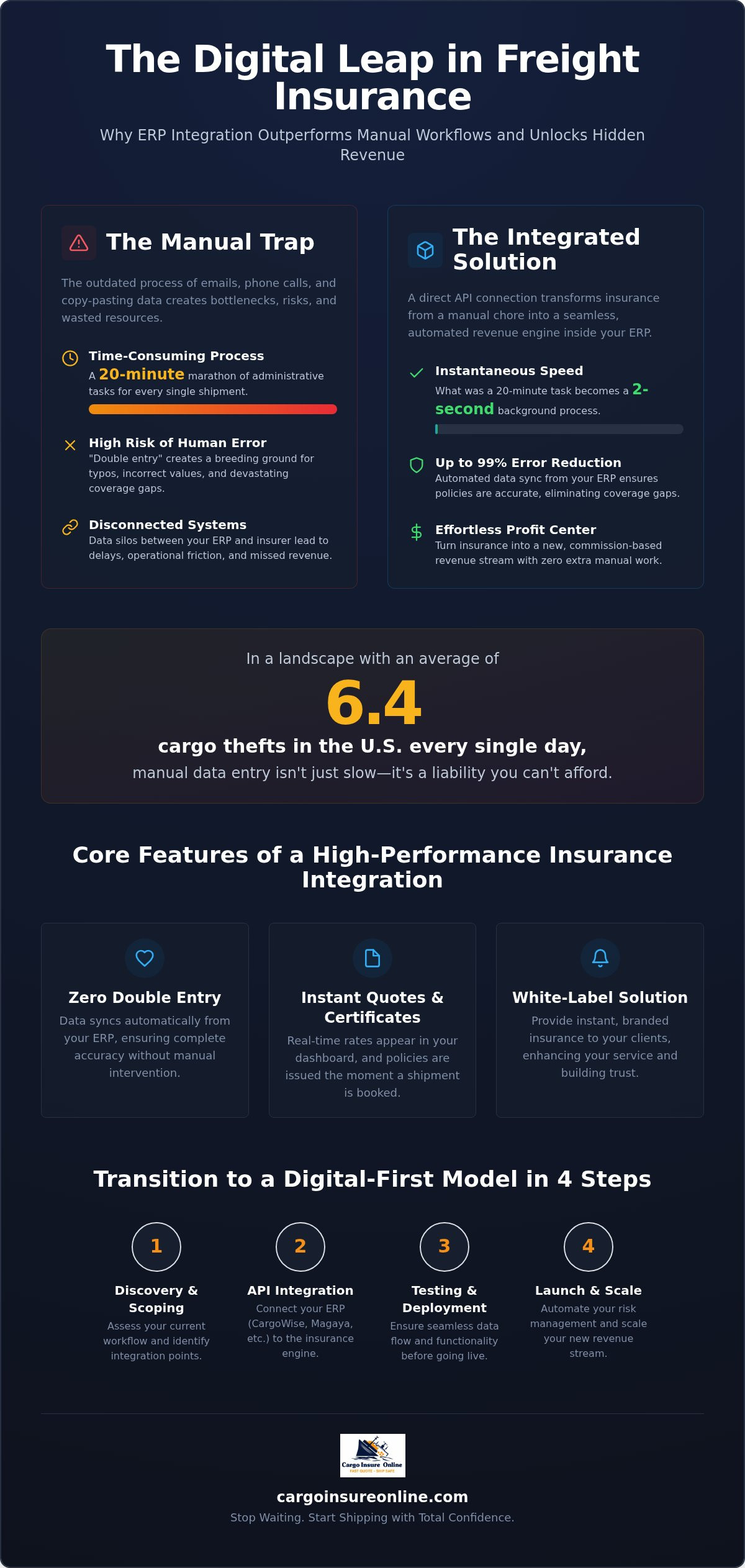
Implementation doesn't have to be a multi-month ordeal. Forget the complex, daunting overviews from legacy consultants. A modern freight forwarder ERP insurance integration is designed for speed and simplicity. You can move from manual chaos to automated precision in four clear steps. It’s about making your tech stack work for you, not against you. The goal is a frictionless transition that delivers immediate ROI.
Start with a thorough audit of your current ERP or TMS. You need to verify third-party API support. Most modern platforms like CargoWise, SAP S/4HANA, or Microsoft Dynamics 365 are already equipped for this connectivity. If your system is closed, it’s time to ask why. Once you confirm compatibility, you’re ready to select your partner and map your data. You’ll need to connect fields like origin, destination, commodity, and value to the API. This ensures the insurer receives the exact data they need to generate a quote in milliseconds.
Selecting the Right Partner
Legacy insurers often offer "bolted-on" tech that feels clunky and slow. Don’t settle for that. Look for a digital-first partner that understands the specific nuances of trucking cargo insurance alongside global air and sea requirements. You need a specialist who provides robust developer support and clear, transparent documentation. This ensures your IT team can deploy the solution without hitting unnecessary roadblocks. A partner who values your time is a partner who values your business.
Technical Deployment Tips
Don't just flip a switch and hope for the best. Use sandbox environments to test every edge case. How does the system handle high-value tech or reefer goods? Testing these scenarios in a safe environment prevents live-market headaches. If you use a major ERP, leverage pre-built connectors to shave weeks off your timeline. Your primary focus should always be the operator’s experience. Keep the workflow "one-click" to ensure your team actually uses the tool. If it isn't easy, it won't scale.
The final step is a pilot launch. Start with a small group of shipments. Monitor the data flow. Verify that certificates are attaching correctly. Once you’re confident in the pipeline, roll it out across your entire operation. You aren't just updating software; you're upgrading your business model. If you're ready to stop waiting and start automating, you can get started with our API integration today. The future of logistics is integrated; don't get left behind.
Cargo Insure Online: Your Branded Insurance Engine
Most competitors treat insurance as a compliance headache. We treat it as a brand-building powerhouse. A freight forwarder ERP insurance integration isn't just about moving data; it's about moving your brand to the center of the customer journey. You aren't just a logistics provider anymore. You're a comprehensive risk management partner. This shift in perception is how you differentiate in a project USD 250 billion global market. It’s about being more than a vendor; it’s about being an essential ally.
The White-Label Advantage
Why send your hard-earned clients to a third-party website to secure their cargo? With white label cargo insurance, you keep the spotlight exactly where it belongs: on you. Our platform offers total customization. Your logo. Your colors. Your unique customer experience. Offering a branded insurance portal builds massive long-term enterprise value by cementing your status as a tech-enabled industry leader. You retain 100% of the customer relationship while we manage the complexities of the risk. It’s your business, powered by our intelligence.
Global trade is evolving rapidly. You need protection that keeps pace with innovation. Our engine provides instant access to niche coverage that legacy providers often ignore. From high-value drones and electronics to temperature-sensitive reefer products, we have you covered. When a claim happens, the friction disappears. We’ve engineered a digital-first claims process that prioritizes speed over paperwork. This keeps your clients happy, loyal, and confident in your ability to handle any disruption. It’s a seamless experience that turns a potential loss into a win for your reputation.
Ready to Integrate?
The era of manual data entry is dead. Our API is built for speed and engineered for the modern freight forwarder who refuses to be slowed down by administrative bottlenecks. We embrace a "Stop Waiting, Start Shipping" mindset that aligns with the pace of your operations. By choosing our freight forwarder ERP insurance integration, you’re joining a digital logistics revolution. You’re choosing profit over paperwork. You’re choosing growth over stagnation. Our digital-first partnership model ensures you have the support you need to scale without the traditional friction of legacy insurance systems.
The paperwork nightmare is officially over. It’s time to empower your team and impress your clients with a solution that works as hard as you do. Launch your branded insurance engine with Cargo Insure Online today.
Secure Your Future in the Digital Logistics Revolution
The days of manual data entry and disjointed workflows are over. You've seen the evidence. A freight forwarder ERP insurance integration isn't just a technical upgrade; it's a fundamental shift in how you protect your business and your clients. By eliminating double entry, you slash human error. You transform a 20-minute administrative chore into a 2-second automated victory. It's time to stop fighting your software and start letting it work for you.
Your business deserves a solution that moves as fast as global trade. Don't let legacy bottlenecks hold back your scalability. You can now offer your own branded insurance engine, securing total customer loyalty while unlocking a consistent revenue stream. With our developer-friendly API documentation, your team can deploy these capabilities faster than you thought possible. It's about empowering your operators and impressing your shippers with every single booking.
It's time to reclaim your time and scale with confidence. Secure instant quotes for air, sea, and trucking shipments while ensuring specialized tech and high-value protection for every piece of cargo. The future of logistics is frictionless, automated, and high-performing.
Automate Your Cargo Insurance Now
Stop reacting to risk and start automating your success. Your digital-first journey begins today, and we're ready to help you lead the way with total confidence.
Frequently Asked Questions
What is freight forwarder ERP insurance integration?
It is the digital bridge between your logistics software and an insurance provider via API. This connection allows for real-time data exchange, meaning you can generate quotes and policies without leaving your primary dashboard. This freight forwarder ERP insurance integration eliminates manual data entry and ensures every shipment is protected at the moment of booking. It is the end of administrative friction and the beginning of automated logistics profit.
How long does it take to integrate an insurance API into my ERP?
Deployment speed depends on your current tech stack, but modern API-first solutions are designed for rapid implementation. If you use a major ERP with pre-built connectors, you can often go live in just a few weeks. Custom integrations might take slightly longer, but with robust developer support and clear documentation, the process is streamlined. We prioritize a "Stop Waiting, Start Shipping" mindset to get your branded engine running fast.
Can I integrate insurance into a custom-built TMS?
Yes, you can absolutely connect a high-performance insurance API to a custom-built Transportation Management System. Our RESTful API architecture is engineered for maximum flexibility, allowing your IT team to map data fields directly to your unique workflow. This ensures even proprietary systems benefit from automated quoting and certificate generation. You don't need an off-the-shelf ERP to join the digital logistics revolution and eliminate manual bottlenecks that slow your growth.
Do integrated quotes cost more than traditional insurance quotes?
No, integrated quotes are typically more cost-effective because they eliminate the high administrative overhead of manual processing. By using a freight forwarder ERP insurance integration, you access real-time market rates for air, sea, and trucking modes without the "manual entry tax." Additionally, the system allows you to set your own markups. This transforms insurance from a cost center into a consistent, commission-based revenue stream for your business with zero extra effort.
How does automated insurance integration handle claims?
Claims are handled through a digital-first portal often accessible directly within your ERP dashboard. Instead of chasing paper trails or waiting for email replies, you can initiate the recovery process instantly. The system pulls all necessary shipment data automatically, ensuring documentation is accurate and complete. This zero-friction approach keeps your clients happy and loyal by accelerating the resolution of disruptions for high-value electronics, drones, or temperature-sensitive reefer products.
Can I use my own branding with an insurance integration?
Absolutely. Our white-label solutions allow you to maintain total control over the customer experience. You can customize the insurance portal with your logo and brand colors, positioning your company as the expert risk manager. This builds massive long-term enterprise value by keeping your brand front and center throughout the shipment lifecycle. You retain the full customer relationship while we provide the sophisticated technology and the specialized risk backing behind the scenes.
Is ERP insurance integration secure for my client data?
Security is a top priority in any digital-first partnership. Modern integrations use encrypted API connections and secure data protocols to ensure your client information remains protected at all times. By automating the data flow, you also reduce the risk of sensitive information being mishandled through manual emails or unencrypted spreadsheets. Our systems are engineered to meet the highest standards of financial service security, providing peace of mind alongside operational efficiency.


