
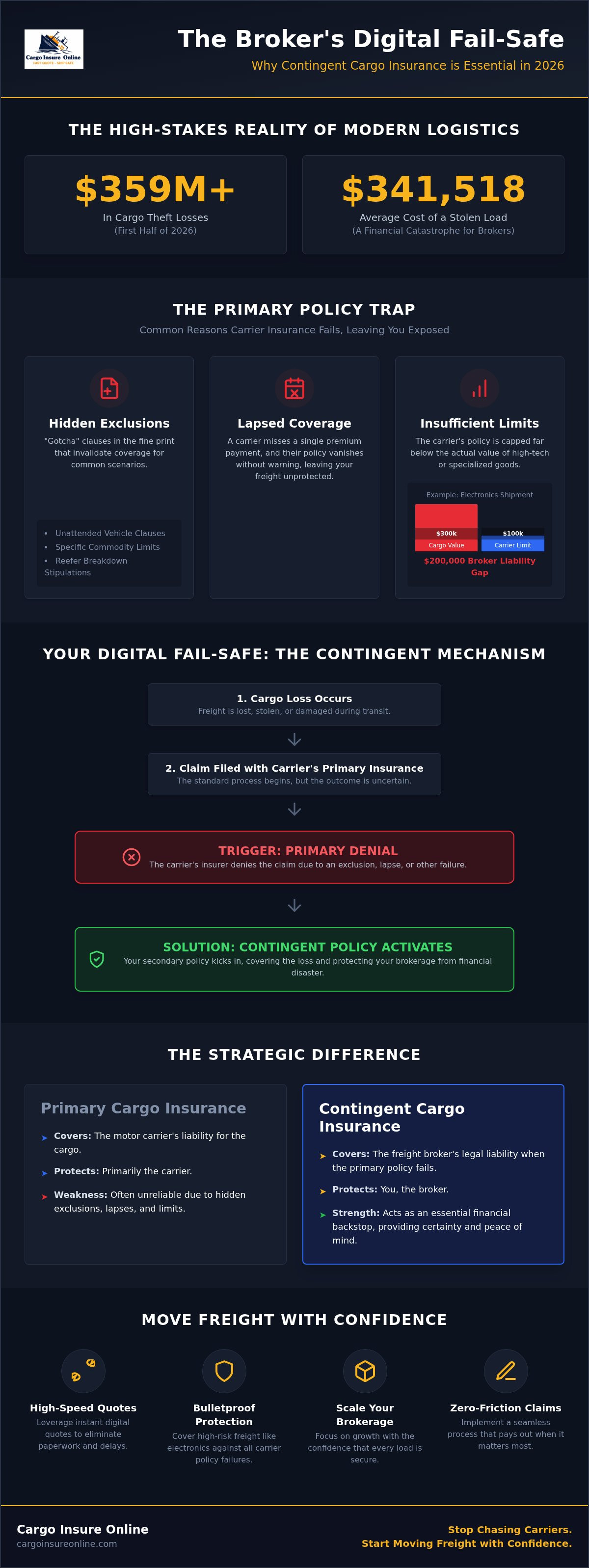
In the first half of 2026, cargo theft losses surged past $359 million, with the average stolen load now costing brokers a staggering $341,518. You've seen the certificates of insurance. You've done the vetting. Yet, one hidden exclusion in a carrier’s policy can still turn a routine shipment into a financial catastrophe. If you’re relying solely on a third-party policy, you aren't just taking a risk; you’re operating without a net. This is why contingent cargo insurance is no longer optional. It is the essential digital fail-safe that transforms a vulnerable middleman into a bulletproof logistics partner.
We know the frustration of legacy insurance hurdles. No more complex paperwork slowing down your workflow. No more "denied claim" nightmares when high-value electronics go missing. We promise to show you how to achieve total protection against carrier insurance failures with high-speed, digital-first coverage. This 2026 guide previews the critical Supreme Court liability shifts from the Montgomery v. Caribe Transport II, LLC ruling and explains how to implement a zero-friction claims process. It's time to stop chasing carriers and start moving freight with absolute confidence.
Key Takeaways
- Master the role of contingent cargo insurance as your essential financial backstop when carrier policies fail or premiums lapse.
- Uncover the "Hidden Exclusion" trap where unattended vehicle clauses and commodity limits render primary coverage useless.
- Differentiate between insuring the cargo and protecting your brokerage’s legal liability to ensure you never pay for a carrier’s mistake.
- Protect high-risk freight like electronics and mobile phones with specialized coverage designed for the 2026 risk landscape.
- Leverage instant digital quotes and white-label solutions to eliminate paperwork and keep your freight moving at high speed.
The Broker’s Fail-Safe: What is Contingent Cargo Insurance?
Forget the dry, bureaucratic insurance models of the past. They’re slow. They’re frustrating. They don't fit the pace of 2026 logistics. We’re flipping the script with a tech-savvy approach to risk. Contingent cargo insurance is the ultimate backstop for modern brokers. It’s the invisible shield that activates when your carrier’s coverage fails. Instead of a financial nightmare, you get a seamless recovery. By 2026, this isn't just a luxury; it's a core requirement for any digital-first brokerage. We’ve moved beyond manual spreadsheets. Today, protection is embedded, automated, and instant.
How the Contingent Mechanism Works
The logistics chain follows a clear path: Shipper to Broker to Carrier. Usually, the carrier's primary cargo insurance policies handle the damage. But what happens when they don't? If a carrier’s insurer denies a claim due to a technicality, you are left holding the bill. This is the "Primary Denial" trigger. It’s a binary switch. If the primary policy says no, your contingent policy says yes. Here is the bottom line for your records: Contingent cargo insurance is a secondary liability policy that provides financial protection to a freight broker if a motor carrier’s primary insurance claim is denied or fails to cover the loss.
This mechanism protects you from several common failure points:
- Policy Exclusions: When a carrier has an "unattended vehicle" clause you didn't know about.
- Lapsed Coverage: When a carrier forgets a premium payment and their policy vanishes.
- Underinsurance: When the carrier’s limit is lower than the actual value of the high-tech goods.
The Broker’s Shield in a Volatile Market
The 2026 market is high-stakes. With average stolen load values hitting $341,518, a single incident can wipe out a year’s profit. Standard carrier liability isn't enough anymore. Criminals are more sophisticated, and policy exclusions are more complex. You need a solution that works at the speed of software. Imagine the relief of never fearing a carrier's policy exclusion again. It’s about more than just money; it's about peace of mind. We’ve removed the friction. No more manual audits. No more waiting days for a quote. You get instant, high-speed protection that lets you focus on scaling your business with total confidence. It’s high-energy risk management for a high-speed industry. Don't settle for manual vetting and crossed fingers. Choose automated, instant-on certainty.
The Primary Policy Trap: Why Carrier Insurance Often Fails
Most brokers believe a Certificate of Insurance (COI) is a golden ticket. It isn't. It’s often a house of cards. You see a $100,000 limit, but you don't see the ten pages of exclusions hiding in the carrier’s full policy. Relying solely on a carrier’s primary coverage is the biggest gamble in modern logistics. If you are still asking What is Contingent Cargo Insurance? it's time to realize that primary carrier policies are often a trap designed to protect the insurer, not your brokerage. We’ve replaced this uncertainty with contingent cargo insurance, giving you a digital safety net that never blinks.
Common Exclusions That Kill Claims
Carrier policies are riddled with "gotcha" clauses. In 2026, these exclusions have evolved. We see claims denied because of cyber-attacks on vehicle telematics or specific drone-related mishaps that standard policies simply don't cover. Cold chain logistics are especially vulnerable. A carrier might have coverage, but a "reefer breakdown" clause might require proof of maintenance that the driver can't produce. This is why reefer cargo insurance needs a strong contingent backstop to ensure cold chain integrity. Carriers have exclusions that leave you exposed. Contingent coverage has your back no matter the fine print.
Beyond technicalities, there is the "Lapsed Policy" nightmare. A carrier misses one premium payment, and their coverage vanishes. You won't know until the claim is denied. Then there's the risk of "Insufficient Limits." If a carrier’s policy is capped at $100,000 but they’re hauling $300,000 in high-value electronics, you are liable for the difference. We don't play those games. Our digital-first approach ensures you aren't left holding a $200,000 bill because of a carrier's oversight.
The Danger of Unverified Carrier Certificates
Trade moves at light speed. Manual verification is a relic of the past that slows down your business and introduces human error. In a world of sophisticated "fake" or expired insurance certificates, a quick glance at a PDF isn't enough. If you’re manually checking certificates, you’re already behind. We’ve eliminated this friction with instant, digital verification. You can secure your brokerage with instant digital cargo protection that bypasses the paperwork. Stop crossing your fingers and start using a sophisticated ally that validates risk in real-time. We’ve turned a bureaucratic chore into a high-speed competitive advantage.
Contingent vs. Primary Cargo Insurance: The Strategic Difference
Primary insurance is about the pallet. Contingent insurance is about your professional survival. It’s a common mistake to think one replaces the other. Primary cargo insurance focuses on the physical goods, covering damage from fire, accidents, or theft. But as a broker, you don't own those goods. You own the responsibility of moving them. If a carrier’s primary policy fails, the shipper doesn't look at the driver; they look at you. Contingent cargo insurance steps in to cover your legal liability when the carrier’s insurer walks away. We’ve replaced the "wait and see" anxiety of legacy insurance with a high-speed, strategic layer of protection.
Who Pays What? A Scenario Breakdown
Understanding the trigger points is vital for zero-friction operations. While a "Shipper’s Interest" policy is great for the client, it doesn't shield you from negligent hiring lawsuits. The May 14, 2026, Supreme Court ruling in Montgomery v. Caribe Transport II, LLC changed the game. Brokers can now be sued in state court for negligent hiring if a carrier fails. Here is how coverage typically splits:
- Theft: Primary pays for the goods. Contingent pays if the carrier’s claim is denied due to driver negligence.
- Storm Damage: Primary pays for the goods. Contingent pays if the carrier has a specific "Act of God" exclusion.
- Handling Errors: Primary pays for the goods. Contingent pays if the broker is held liable for selecting an unqualified carrier.
Limits matter too. In our Air Freight Insurance guide, we highlight how international air limits are often too low for high-value tech. We bridge that gap instantly.
Protecting Your Professional Reputation
Reliability is your most valuable currency. When a claim hits a wall, you have two choices: tell your shipper "too bad" or be the broker who always pays. We choose the latter. Having a contingent cargo insurance layer allows you to satisfy your shipper immediately, even while the carrier’s insurer is still shuffling paperwork. It’s about building a vibrant, high-energy relationship with your clients. You aren't just a middleman; you’re a sophisticated ally. This is especially critical on the water. Our sea freight insurance contingent layers protect you against the complexities of General Average, where every party on a ship is liable for losses. We’ve removed the friction, so you can keep your freight, and your reputation, moving at light speed.
2026 Risks: Contingent Coverage for High-Tech and Specialized Freight
High-value freight moves at the speed of thought in 2026. If your brokerage is handling iPhones, medical devices, or high-end drones, you're likely walking a tightrope. Standard carrier policies haven't kept pace with the tech explosion. Many carriers still use legacy forms with hidden exclusions for target commodities like mobile devices. This is a recipe for a denied claim nightmare. Contingent cargo insurance is the only way to ensure your brokerage survives a high-value loss when the carrier’s insurer points to the fine print. We've simplified this complexity into a digital-first solution that works as fast as you do.
The Tech-Freight Explosion: Mobile Phones and Drones
Mobile phones are high-velocity, high-risk assets. They are the top target for organized cargo theft, which saw a massive surge in the first half of 2026. Many carriers have "unattended vehicle" clauses that specifically target electronics. If a driver leaves a trailer for ten minutes and the tech vanishes, the carrier’s policy won't pay. This is why electronics shipping insurance requires a robust contingent backstop. It’s your safety net against the "gotcha" clauses of legacy insurers.
Drone shipping is the new frontier of logistics risk. Liability limits for UAV carriers are still untested territory in 2026. When a drone goes down or a payload is intercepted, who is responsible? We’re the specialists in these high-tech niches. We provide the clarity you need when the carrier's policy is a question mark. We've removed the friction from tech-freight, allowing you to say yes to high-value shippers without the sweat.
Multimodal Contingent Risks: Air and Sea
Don't fall for the myth that contingent coverage is just for trucks. It’s vital for global trade. International conventions like the Montreal Convention for air or COGSA for sea are designed to protect carriers, not you. They often cap liability at a fraction of the cargo's value. If an air carrier loses a crate of high-end sensors, they might only pay out a few dollars per kilo. This "Limited Liability" trap can leave you with a massive financial gap.
For cross-border e-commerce insurance, you need a bridge between these international limits and the actual cargo value. Contingent cargo insurance provides that bridge. It ensures that when a ship encounters a General Average event or a plane loses a pallet, your brokerage isn't the one paying the difference. We’ve turned this complex global risk into a seamless digital experience. You get the protection you need without the paperwork. It’s time to move beyond the limited liability of the past. Secure your shipments with instant high-value cargo protection and keep your freight moving with total confidence.
Scale Your Brokerage: Digital-First Contingent Solutions
Legacy insurance is a bottleneck. It’s slow. It’s manual. It’s full of "Contact Us" forms that disappear into a digital black hole. We’ve killed that model. Scaling your brokerage in 2026 requires a tech-first approach to contingent cargo insurance. You need instant quotes, not endless email chains. You need total clarity, not vague PDF brochures. We’ve removed every ounce of friction so you can focus on moving more loads. Every shipment is a growth opportunity when your risk management is automated and invisible. We’ve transformed a perceived administrative chore into a seamless, positive experience for you and your shippers.
Branded Insurance: The Competitive Edge
Competition is fierce. To stand out in a crowded market, you need to offer more than just basic logistics. By utilizing white label cargo insurance, you can launch your own branded insurance engine. This isn't just a fancy perk. It’s a strategic advantage that keeps shippers inside your ecosystem. Imagine integrating a sophisticated insurance engine directly into your TMS. Your clients get high-speed protection with a single click. This is the era of "Embedded Insurance." It’s seamless. It’s fast. It’s the standard for 2026 freight. When a loss occurs, our digital claims process moves at the speed of software. We’ve cut the wait time from weeks to days. From the moment of loss to the final payout, we prioritize your cash flow and your client’s reputation.
Trucking Insurance Built for the Open Road
Road freight remains the backbone of the global supply chain, but it’s also where the most volatility lives. Check out our Trucking Cargo Insurance guide for deep-dive strategies on road-specific contingent protection. For small brokers and growing agencies, "Per-Load" contingent cargo insurance is a total game-changer. You don't need to commit to a massive annual premium just to get started. You scale only as you ship. This flexibility allows for agile risk management that respects your margins. It’s about empowerment, not limitation. We’ve built a system where small players can have the same bulletproof protection as the giants.
No more bureaucratic chores. No more gaps in your safety net. Just freight moving at the speed of digital trade. No friction. No gaps. Just freight. Stop waiting for carrier certificates to arrive in your inbox. Start shipping with total, bulletproof protection today.
Secure Your Future in the 2026 Freight Market
Legacy insurance is a dead end. It’s slow, manual, and leaves you exposed to the primary policy trap. You’ve seen how contingent cargo insurance acts as your ultimate fail-safe, bridging the gap between carrier liability limits and the actual value of your tech-heavy freight. By shifting to a digital-first strategy, you eliminate the friction of manual certificate checks and the nightmare of denied claims. You aren't just a middleman anymore. You are a sophisticated logistics ally equipped with global multimodal coverage and specialized high-value tech protection.
The future of freight is embedded, automated, and bulletproof. Stop crossing your fingers and start moving shipments with absolute certainty. Whether you’re integrating white-label solutions or securing per-load protection, the tools to scale your brokerage are ready. It’s time to transform your risk management from a bureaucratic chore into a high-speed competitive advantage. We’ve removed the obstacles so you can focus on growth.
Get Your Instant Contingent Cargo Quote Now and experience the relief of total protection. Let's keep your freight moving at light speed.
Frequently Asked Questions
What is the biggest difference between cargo insurance and contingent cargo insurance?
Primary cargo insurance covers the physical goods directly against damage or theft. In contrast, contingent cargo insurance protects the freight broker’s liability when the carrier's primary policy fails or is denied. It’s your essential backstop. While the carrier’s policy focuses on the pallet, your contingent policy focuses on your professional survival. It ensures you aren't left holding the bill when a carrier’s insurer points to the fine print.
Does a freight broker legally need contingent cargo insurance in 2026?
While not a federal mandate like the $75,000 FMCSA surety bond, it is a commercial necessity in 2026. The Supreme Court ruling in Montgomery v. Caribe Transport II, LLC allows brokers to be sued in state court for negligent hiring. Without this coverage, a single lawsuit or a denied carrier claim could bankrupt your brokerage. It’s the professional standard for modern risk management and total peace of mind.
Will contingent cargo insurance cover me if the carrier has no insurance at all?
Yes, standard contingent policies are designed to trigger if the carrier's insurance is non-existent, lapsed, or invalid at the time of the loss. You must still perform due diligence by verifying their coverage at the start of the contract. Our digital-first tools automate this vetting process. You get a bulletproof fail-safe that activates even when a carrier's paperwork turns out to be an expired relic of the past.
How much does contingent cargo insurance cost for a small brokerage?
Costs vary based on your annual volume and the specific commodities you move. In 2026, many brokers find that "Per-Load" insurance options provide the most flexible and scalable pricing. This allows you to pay only for the protection you need as you ship. Instead of heavy annual premiums, you get a high-speed solution that fits your specific margins and current growth stage. No friction, just scalable protection.
Can I get contingent coverage for high-value electronics and drones?
Absolutely. We specialize in niche protection for high-value assets like mobile phones, electronics, and drones. These items are often excluded or severely limited by standard carrier policies. Our contingent solutions bridge that gap. We ensure your brokerage is protected against the high theft risks and unique liability limits associated with 2026 tech-freight. You get specialized protection without the bureaucratic friction of traditional, slow-moving insurance providers.
How fast can I get a quote with Cargo Insure Online?
You can get an instant digital quote for air, sea, or trucking freight in seconds. We’ve eliminated the slow "Contact Us" forms and manual applications that stall your workflow. Our automated engine provides total clarity and high-speed results. This allows you to secure coverage and keep your freight moving without missing a beat. It’s insurance built for the open road and the speed of modern global trade.
What is the "Primary Denial" trigger in a contingent policy?
The "Primary Denial" trigger is the specific condition where your contingent policy activates. It happens when the carrier’s primary insurer officially denies a claim due to a policy exclusion, like an unattended vehicle clause, or because the carrier’s coverage lapsed. It’s a binary fail-safe. If the primary policy says "no," your contingent cargo insurance steps in to protect your brokerage from the financial fallout of a carrier's failure.
Does contingent cargo insurance cover international sea and air freight?
Yes, our solutions provide global multimodal coverage for sea and air freight. International conventions like the Montreal Convention or COGSA often limit carrier liability to very low "per-kilo" amounts. Contingent coverage allows brokers to bridge the gap between these low limits and the actual value of the cargo. It ensures total protection across the entire supply chain. You get a sophisticated ally that works regardless of the transport mode used.


