
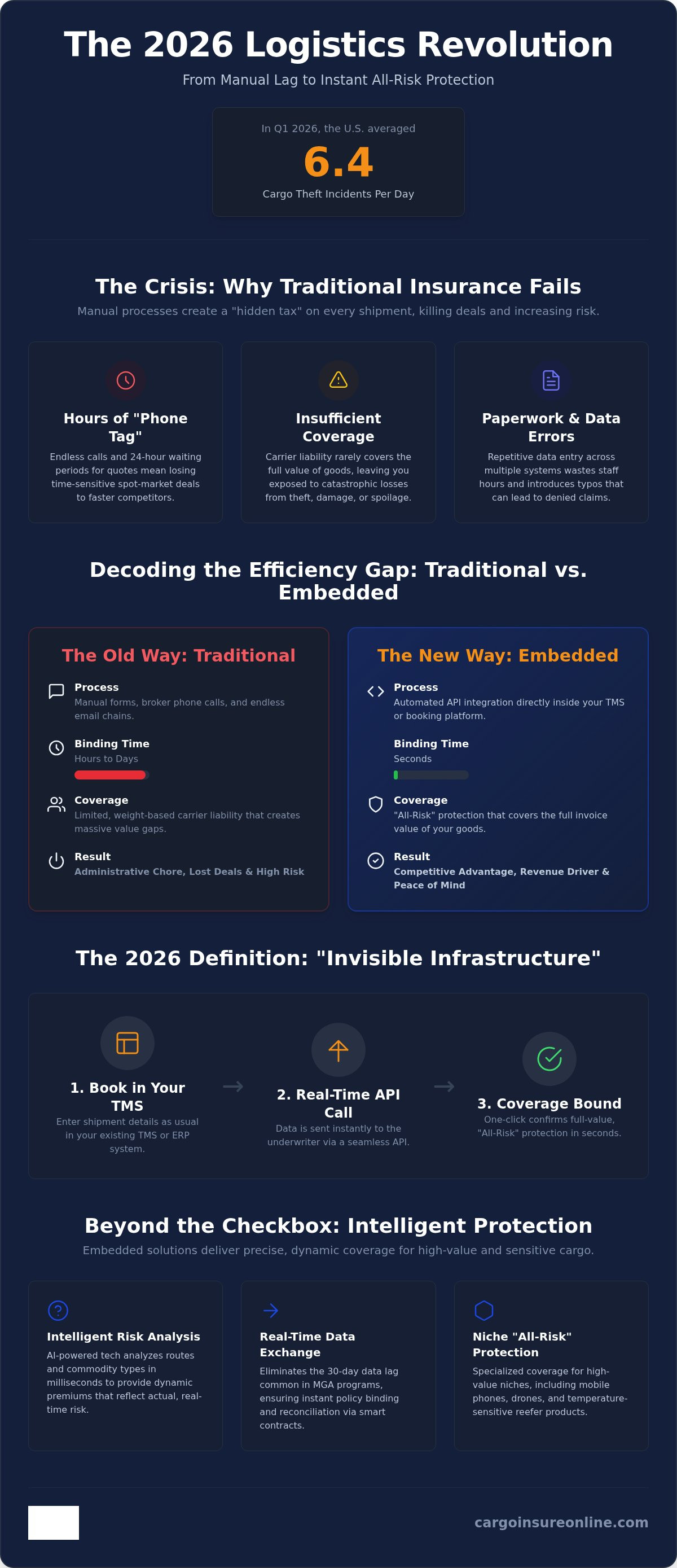
The U.S. averaged 6.4 cargo theft incidents every single day in the first quarter of 2026. While theft surges, most logistics providers are still stuck playing "phone tag" with brokers and drowning in manual paperwork. You know the frustration of losing a spot-market deal because a quote took hours instead of seconds. You've felt the sting when carrier liability limits fail to cover high-value electronics or reefer spoilage. It's a slow, bureaucratic system that doesn't fit the high-speed demands of modern trade.
It's time to stop treating protection as a bottleneck and start seeing it as a competitive edge. By leveraging embedded cargo insurance for logistics, you can eliminate manual friction and turn risk management into a high-speed revenue driver. We promise to show you how to move from an administrative chore to instant, one-click binding without the headache. This article previews the 2026 digital-first revolution, covering everything from AI-powered pricing to the new mandates for real-time data exchange. Discover how to provide a seamless customer experience that builds trust and secures every shipment with full-value, All-Risk protection.
Key Takeaways
- Eliminate the "phone tag" and manual paperwork that kill spot-market deals. Learn to replace administrative friction with high-speed digital workflows.
- Discover how embedded cargo insurance for logistics functions as invisible infrastructure, integrating directly into your booking workflow via API.
- Slash your binding time from hours to seconds while shifting from generic policies to precise, asset-specific coverage.
- Master specialized "All-Risk" protection for high-value niches, including mobile phones, drones, and temperature-sensitive reefer products.
- Transform cargo protection into a revenue driver by launching a branded insurance engine using flexible white-label solutions.
The UX Crisis: Why Traditional Cargo Insurance is Killing Your Logistics Speed
Traditional cargo insurance is a relic. It's built on manual forms, endless broker "phone tag," and frustrating 24-hour waiting periods. In the high-velocity logistics world of 2026, this friction doesn't just slow you down; it kills your deals. You've likely seen spot-market loads vanish because a quote took too long. You've watched shipments go uninsured because the paperwork felt like a mountain. This isn't just an inconvenience. It's a UX crisis.
Stop waiting for brokers to call you back. Start binding in seconds. The shift to embedded cargo insurance for logistics isn't just a tech upgrade. It's a survival strategy. 2026 demands a digital-first approach to risk management where protection is as fast as the booking itself.
The High Cost of the "Manual Lag"
Manual processes act as a hidden tax on every shipment. Every minute spent chasing a certificate is a minute lost on operations. This "manual lag" often means missing out on high-value contracts that demand instant coverage confirmation. If you can't prove protection at the point of booking, the client moves to a competitor who can. The costs of sticking to the old way are clear:
- Lost revenue from spot-market deals that require instant binding.
- Increased exposure to theft, especially as deceptive pickup schemes surged by 31% in early 2026.
- Wasted staff hours on repetitive data entry and broker follow-ups.
Don't rely on carrier liability as a safety net. It's often a false one. Standard carrier limits rarely cover the actual value of high-tech electronics or sensitive reefer goods. When a claim happens, the administrative overhead of fighting for a payout can often outweigh the actual recovery.
Moving from Administrative Chore to Competitive Advantage
Insurance shouldn't be a "necessary evil" hidden in the back office. It's a powerful customer-facing feature. When you offer instant, one-click protection, you build immediate trust. Your clients feel the relief of knowing their cargo is safe before the truck even arrives. It transforms your brand from a basic freight mover into a sophisticated, secure partner.
This transition changes the conversation from "how much does it cost?" to "how fast can we move?". While carrier liability typically limits compensation to a fixed per-kilo amount based on weight, All-Risk protection covers the full invoice value of the goods regardless of the carrier's fault. By integrating embedded cargo insurance for logistics, you transform a boring administrative chore into a high-speed competitive advantage. You aren't just moving freight; you're providing peace of mind at the speed of light.
What is Embedded Cargo Insurance? The 2026 Definition
In 2026, insurance isn't a destination. It's a feature. Embedded cargo insurance for logistics is the native integration of protection directly into your booking workflow via API. Think of it as "Invisible Infrastructure." It lives inside your TMS or ERP. It doesn't require a separate login. It doesn't demand a new tab. It just works. Unlike traditional "per-load" policies that require manual negotiation for every unique shipment, embedded solutions use real-time data to provide instant All-Risk coverage. This ensures you are protecting the full invoice value of the goods, not just a weight-based carrier limit that leaves you exposed.
The API Engine: Under the Hood of Embedded Tech
The magic happens through a seamless data flow. When you enter shipment details on your booking screen, that information travels to the underwriter instantly. There is no manual data entry. There are no typos that lead to denied claims. By Q4 2026, capacity providers are mandating real-time data exchange (RTDX). This is a direct response to the industry's data lag problem, where 60% of MGA-led programs suffer from 30-day delays in reconciliation. Smart contracts solve this by ensuring insurance binds the moment the "book" button is clicked. It's instantaneous. It's effortless. It's the speed of modern trade.
Beyond the Checkbox: Intelligent Risk Management
This isn't a generic "yes/no" checkbox. It's intelligent. The tech identifies high-risk routes before the ship even sails. It analyzes thousands of variables in milliseconds to provide dynamic premiums that reflect actual risk. It automatically adjusts coverage levels based on commodity types. For example, electronics shipping insurance requires specialized All-Risk terms that a generic policy simply can't offer. You get precision protection for high-value tech without the manual back-and-forth. This proactive risk management builds a stronger, more resilient supply chain for your clients.
If you're ready to stop the paperwork and start the progress, exploring digital-first insurance solutions is the logical next step for your business growth.
Embedded vs. Traditional: Decoding the Efficiency Gap
The gap between traditional methods and digital innovation isn't just a crack; it's a canyon. Traditional insurance relies on broker negotiation that often drags on for days. Embedded cargo insurance for logistics settles the matter in seconds. This isn't just about speed. It's about precision. Instead of a generic "one size fits all" policy, you get asset-specific coverage tailored to the exact load. Scalability used to be an administrative nightmare. Handling 1,000 shipments required a small army of clerks. Now, the API handles one or one thousand with the same effortless efficiency. Even claims are evolving. Forget bureaucratic paper trails. Digital-first, evidence-based processing means faster resolutions and zero friction for your team.
Why "All-Risk" is the Gold Standard for 2026
Carrier liability is a trap for the unwary. It's usually based on weight, not actual value. If a high-value drone is crushed, a "per-kilo" payout won't even cover the shipping box. All-Risk protection is the gold standard for 2026 because it covers the full market value of the goods. It safeguards against theft, damage, and catastrophic loss without the need to prove carrier negligence. This is especially critical for time-sensitive modes. See how air freight insurance handles high-speed transit risks where the margin for error is zero.
The Revenue Factor: Turning a Cost Center into a Profit Center
Stop viewing insurance as a necessary expense. Start seeing it as a high-margin profit center. In the old model, insurance was a cost you passed through or simply absorbed. With the embedded cargo insurance for logistics model, you can earn commissions or service fees on every policy bound. You increase your "Revenue per Shipment" without adding any operational complexity. By offering protection at the point of sale, you provide a value-added service that clients actively seek. It’s a seamless win-win. Your client gets instant peace of mind. You get a new, scalable revenue stream that grows with your volume.
Niche Protection: Embedded Solutions for High-Value Logistics
High-value logistics isn't just about moving boxes. It's about moving high-stakes assets. Traditional policies often treat a container of grain the same as a container of high-end electronics. That's a recipe for financial disaster. The shift toward embedded cargo insurance for logistics allows for specialized API logic that understands the difference between commodities. Tech moves fast. Theft moves even faster. In early 2026, the theft of auto parts alone surged by 142%. This highlights a massive trend: high-value, easily fenced goods are under fire. You need protection that is as smart as the goods you're carrying.
Safeguarding the Tech Revolution
Mobile phones and drones are prime targets for sophisticated theft rings. You can't protect a drone shipment with a policy designed for bulk lumber. These shipments require specialized "All-Risk" terms that address the unique risks of the tech sector. Drone shipping is no longer a future concept; it's the 2026 reality for last-mile delivery. Protecting these assets requires API logic that can calculate risk based on device type, value density, and destination. It's about moving from generic coverage to a surgical strike of protection. This precision ensures that if a shipment of the latest smartphones goes missing, your business isn't left holding a weight-based payout that covers pennies on the dollar.
Temperature-Sensitive Success
The cold chain has zero room for error. A single mechanical failure can lead to total spoilage of life-saving pharmaceuticals or fresh produce. While traditional carriers often exclude mechanical breakdown, reefer cargo insurance within an embedded framework solves this. The "Zero-Loss" goal is finally achievable. By integrating with IoT sensors, embedded cargo insurance for logistics validates risk in real-time. If the temperature spikes, the system knows. If the compressor fails, the claim evidence is already recorded. This level of connectivity turns a shipment into a data-driven journey.
This frictionless protection extends to the e-commerce giants. Amazon FBA and Shopify sellers demand speed. They don't have time for manual broker quotes or 24-hour delays. They need protection that works across air, sea, and trucking cargo insurance routes without a second thought. Whether you are moving high-tech devices or temperature-sensitive meds, the right tech stack makes the difference. Ready to upgrade your niche protection? Secure your high-value shipments today with a digital-first partner that understands the complexity of 2026 logistics.
How to Launch Your Branded Insurance Engine with Cargo Insure Online
Launching a digital-first insurance program isn't a month-long integration project. It's a strategic pivot. The global embedded insurance market is projected to hit 145.25 billion USD in 2026. You don't want to be left watching from the sidelines. Taking control of your insurance offering is a four-step journey to higher margins and better UX.
- Step 1: Identify your high-volume routes and high-value cargo niches. Focus on where the risk is highest and the manual friction is most painful.
- Step 2: Choose your integration level. Whether you need a deep API connection, a standalone portal, or a fully branded cargo insurance platform, the tech scales with your needs.
- Step 3: Set your commercial parameters. Define your revenue share models and decide how you want to monetize the protection you provide to your shippers.
- Step 4: Go live. Offer instant, frictionless protection to every client at the point of booking and watch your "Revenue per Shipment" climb.
White Label: Your Brand, Our Tech
Maintaining client trust is paramount. You've spent years building your reputation; don't outsource that relationship to a third-party interface. Our "Plug-and-Play" engine allows the entire experience to live under your own brand. You provide the user experience. We provide the regulated infrastructure. This approach significantly reduces your compliance and licensing burdens. You get the benefits of being an insurance provider without the legal headache. It's about turning a necessary service into a premium product that you own and control.
The Future: Predictive Insurance and AI Underwriting
The next three to five years will move beyond simple integration into the world of predictive protection. Imagine a system that predicts a cargo theft hotspot before the truck even enters the zip code. AI underwriting will analyze real-time data to adjust premiums on the fly based on weather patterns or port congestion. Cargo Insure Online is leading this 2026 digital-first movement by eliminating the 30-day data lag that plagues traditional MGAs. The era of reactive insurance is over. Proactive, embedded cargo insurance for logistics is the new standard for global trade. Don't wait for the industry to move past you. Launch your digital insurance engine today and secure your spot at the front of the logistics revolution.
Scale Your Logistics with Digital-First Certainty
The days of manual lag are over. Traditional insurance is a bottleneck. Digital-first protection is an engine. By adopting embedded cargo insurance for logistics, you can slash binding times from days to seconds. You've discovered how to protect high-value niches like electronics, drones, and reefer products with specialized "All-Risk" terms that actually cover the invoice value. This isn't just about risk; it's about revenue.
You can now offer global coverage across air, sea, and land while maintaining your own brand through seamless white-label and API integration. Stop settling for broker phone tag. Start empowering your clients with instant certainty. The logistics revolution is happening right now. You have the tools to transform a bureaucratic chore into a high-speed competitive advantage. It's time to move.
Stop the manual lag and launch your digital insurance engine with Cargo Insure Online. The future of freight is frictionless. We're ready when you are.
Frequently Asked Questions
Is embedded cargo insurance more expensive than traditional policies?
No, it is often more cost-effective because it eliminates manual broker commissions and heavy administrative overhead. Traditional policies bake in the cost of manual labor; digital-first models pass those efficiency savings directly to you. You pay for the actual risk rather than the paperwork. It transforms a fixed cost into a dynamic, shipment-specific expense that scales perfectly with your business volume.
How long does it take to integrate a cargo insurance API into my platform?
Integration typically takes days, not months. Modern APIs are designed for "plug-and-play" simplicity with comprehensive documentation. You don't need a massive development team to get started. Most logistics providers can go live within a week of choosing their integration level. It is a fast-track to upgrading your tech stack without the typical software deployment headache or long-term delays.
Does embedded insurance cover international sea and air freight?
Yes, it provides global coverage across air, sea, and land routes. Whether you're moving freight across the Atlantic or trucking through Europe, the protection follows the cargo. It is built for the complexities of global trade. You get consistent All-Risk protection that spans every freight mode, ensuring your international shipments remain secure from origin to destination without any gaps in coverage.
What happens if I need to file a claim with an embedded insurance provider?
The claims process is digital-first and evidence-based for maximum speed. You submit documentation through the portal rather than mailing physical forms. Digital synchronization means the underwriter receives the data instantly. In 2026, many claims are processed in a fraction of the time required by traditional brokers. It replaces bureaucratic paper trails with a streamlined, transparent resolution experience that respects your time.
Can I use embedded insurance for high-value electronics and reefer goods?
Absolutely, it is specifically designed for high-value electronics and reefer goods. Generic policies often fail here, but embedded cargo insurance for logistics uses specialized API logic to handle these unique risks. You get protection for mechanical breakdown and theft that standard carrier liability ignores. It is the only way to ensure full-value recovery for sensitive, temperature-controlled shipments or high-tech devices.
Do I need special licensing to offer white-label cargo insurance to my clients?
No, you usually don't need special insurance licensing to offer white-label solutions. You leverage our regulated infrastructure and existing licensing. We handle the compliance while you focus on the customer experience. This "as-a-service" model removes the legal barriers that traditionally stopped logistics firms from offering insurance. You gain a new revenue stream without the heavy regulatory burden or legal fees.
Can embedded insurance replace my existing annual open cover policy?
Yes, it can replace or supplement annual open cover policies. Annual policies often charge you for "phantom" risks or force you into high minimum premiums. embedded cargo insurance for logistics allows you to pay only for what you actually ship. It offers better flexibility for businesses with fluctuating volumes or specialized cargo needs. You move from a rigid contract to a scalable, on-demand model.
Is embedded insurance compatible with major TMS and ERP systems?
It is fully compatible with major TMS and ERP systems via flexible API endpoints. Most modern platforms support RESTful APIs, making the connection seamless. You don't have to change your existing workflow. The insurance engine lives inside your current environment, pulling data automatically to eliminate manual entry errors. It is a frictionless upgrade for your existing digital ecosystem that builds immediate operational value.


