
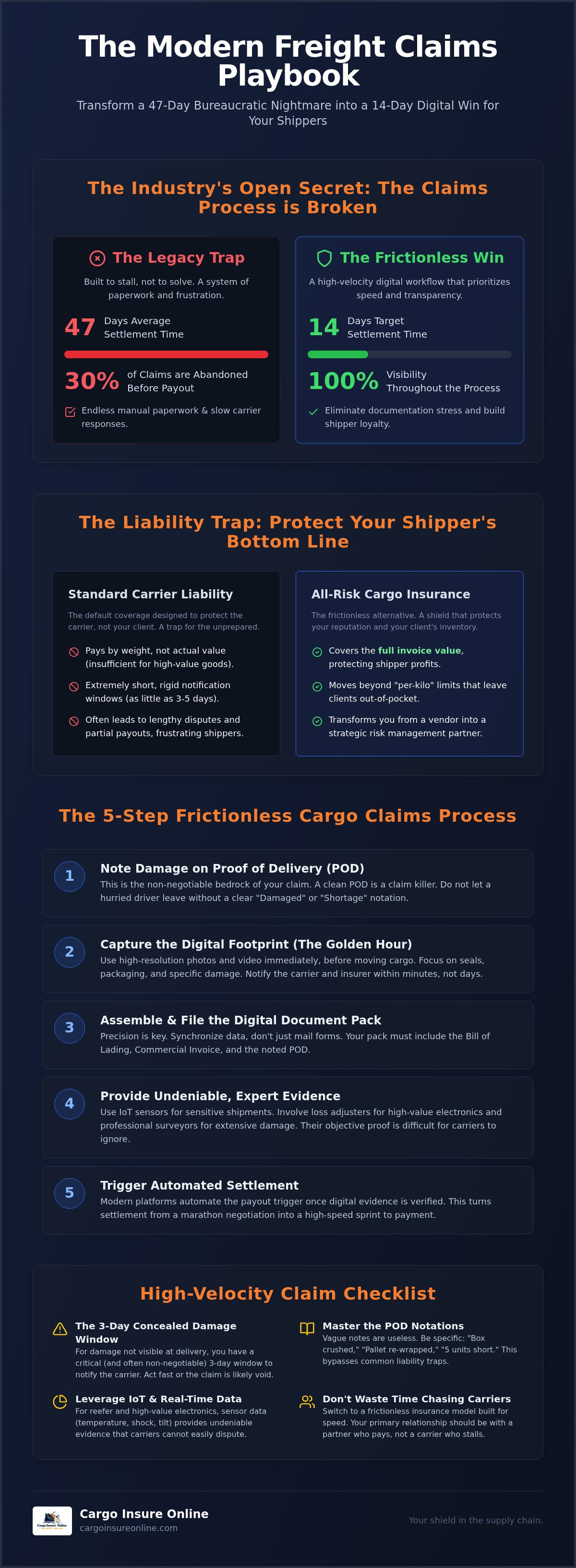
30% of filed freight claims are abandoned before a single cent is paid out. According to CorePiper data from April 2026, the average manual freight forwarder cargo claims process drags on for 47 days of silence and frustration. You are likely exhausted by slow carrier responses and the endless pile of manual paperwork. It is the industry’s open secret. Legacy systems are built to stall, not to solve. We are here to change that narrative.
We agree that waiting 120 days for a motor carrier to settle a claim is unacceptable. You deserve a system that prioritizes speed and digital transparency. This 2026 guide promises to help you master a high-speed workflow that transforms a bureaucratic nightmare into a frictionless win. We will preview the exact steps to slash settlement times to just 14 days, eliminate documentation stress, and keep your shippers smiling. It is time to stop fighting the process and start winning it.
Key Takeaways
- Master the freight forwarder cargo claims process. Ditch slow manual paperwork for high-velocity digital workflows.
- Avoid instant denials. Learn the exact notations required on Proof of Delivery documents to bypass common liability traps.
- Use IoT sensors and real-time data. Provide undeniable evidence for sensitive reefer and high-value electronics shipments.
- Act fast on concealed damage. Submit notifications before the critical three-day window slams shut and voids your claim.
- Don't waste time chasing unresponsive carriers. Switch to a frictionless insurance model built for speed and transparency.
The Freight Forwarders Shield: Understanding the Claims Ecosystem
The freight claim is the ultimate test of a freight forwarder’s reliability. It is the moment of truth. When cargo arrives crushed or soaked, the shipper does not care about your logistical brilliance; they care about their bottom line. Traditional claims are slow and painful. Modern claims are high-velocity and digital. If you are still using spreadsheets to track damage, you are already behind the curve.
In this ecosystem, three players define the outcome: the Shipper, the Forwarder, and the Carrier. Shippers want speed and full reimbursement. Carriers want to limit payouts and protect their margins. You, the forwarder, sit in the middle. Legacy systems treat this as a battle of paperwork. We treat it as a race of data. Relying on legacy carrier liability is a trap for the unprepared. It is a system designed to protect the carrier’s interests, not your reputation or your client’s inventory.
Carrier Liability vs. All-Risk Insurance
Carrier liability is limited by law, and those limits are tight. Under the Hague-Visby Rules for sea freight, you often have just three days to give notice of damage. US domestic trucking under the Carmack Amendment offers a nine-month window for filing, but individual carrier tariffs often slash that notification period to just five days. These limits are rigid and often pay out by weight rather than the actual value of the goods. Carrier liability is often insufficient for high-value tech because it caps payouts at a fraction of the actual replacement cost. All-risk insurance is the frictionless alternative. It covers the full invoice value, moving beyond the "per-kilo" rate that leaves shippers out of pocket and frustrated.
The Forwarder as a Strategic Ally
You are no longer just a middleman. In 2026, you are a risk management partner. Shippers expect more than a simple booking; they expect a shield. A manual freight forwarder cargo claims process is a loyalty killer. It is slow, opaque, and reminds the customer of their loss every day it remains unresolved. Moving from a manual approach to a digital-first platform transforms your service. It creates a seamless experience where data flows instantly from the point of damage to the settlement desk. This shift builds long-term loyalty. When you resolve a claim in 14 days instead of the industry average of 47, you aren't just a vendor. You are an essential ally in their supply chain.
The 5-Step Frictionless Cargo Claims Process
Speed is the only currency that matters in a modern freight forwarder cargo claims process. Forget the old way of waiting weeks to assess damage. If you don't act within the first hour of delivery, you're already losing. According to federal regulations on cargo claims, carriers have specific timelines to acknowledge and pay, but your clock starts the second the ramp drops. You must be proactive to win.
Step 1 & 2: The Golden Hour of Claims
Note damage on the Proof of Delivery (POD) immediately. There are no exceptions. A clean POD is a claim killer. If the driver is rushing, don't let them leave until the notation "Damaged" or "Shortage" is clear and legible. This is the bedrock of your evidence. It is the difference between a fast settlement and a total denial. Don't let a hurried driver dictate your financial recovery.
Capture the digital footprint. Use high-resolution photos and video before moving a single pallet. Focus on the seals, the packaging, and the specific area of damage. In 2026, digital evidence is the industry standard. Notify the carrier and your insurer within minutes, not days. Speed creates leverage; silence creates doubt. The faster you upload your photos, the harder it is for a carrier to claim the damage happened after delivery.
Step 3 to 5: From Filing to Funds
Formal filing is no longer about mailing thick stacks of forms. It is about data synchronization. Assemble your digital document pack with precision. You need the Bill of Lading, the Commercial Invoice, and the noted POD. For high-value electronics and drones, involve a loss adjuster early. They provide the technical expertise needed to prove functional damage that might not be visible to the naked eye. This prevents carriers from denying claims based on technicalities or "hidden" defects.
Investigation is the moment of truth. If the damage is extensive, call in the experts. Professional surveyors provide the objective proof that carriers cannot ignore. In the maritime world, sea freight insurance becomes your primary defense against General Average, where you could be liable for others' losses during a maritime emergency. The final settlement should be a sprint, not a marathon. Modern platforms automate the payout trigger once the digital evidence is verified. If you are ready to ditch the manual paperwork and embrace high-velocity results, explore frictionless insurance solutions that put your business first.
The Liability Trap: Why Most Forwarder Claims Fail
Most claims die in the carrier’s inbox. It is not bad luck; it is bad data. The freight forwarder cargo claims process is often derailed by simple, avoidable mistakes that carriers exploit to protect their margins. Vague descriptions on the Proof of Delivery (POD) are the top reason for denial. If your receiver signs "subject to inspection," you have already lost. Carriers view that phrase as legally meaningless. You need specific, visible proof. Write "crushed corner," "broken seal," or "wet packaging" instead. Be precise or be prepared for a rejection letter.
The "Concealed Damage" hurdle is another silent killer. Under the Hague-Visby Rules for ocean freight, you have exactly three days to report non-visible damage. If you wait until day four to unbox your shipment, the carrier will deny your claim instantly. Road freight under the CMR Convention gives you seven days, while air cargo under the Montreal Convention allows fourteen. US domestic trucking is even more volatile. While the Carmack Amendment allows nine months for formal filing, individual carrier tariffs often slash the notification window for concealed damage to just five days. Miss these windows, and your legal standing evaporates.
The Per-Kilo Rule: A Financial Disaster
Carrier liability is a financial trap for high-value goods. Under COGSA, ocean carrier liability is often capped at just $500 per package. Imagine a $50,000 drone arriving as a total loss. If that drone is considered a single "package," you might only recover 1% of its value. The Montreal Convention for air freight uses weight-based limits that are equally punishing for lightweight, expensive tech. Using electronics shipping insurance eliminates this risk. It ensures you are paid based on the actual invoice value, not a "per-kilo" rate that ignores the reality of your inventory.
Documentation Gaps That Kill Claims
Documentation gaps turn valid claims into expensive lessons. The "Clean POD" myth is the most dangerous. If a receiver signs without noting damage, the burden of proof shifts entirely to you. You must also mitigate your loss. You cannot simply abandon the cargo; you are legally required to save what is salvageable. If you fail to protect the remaining goods, the carrier will deduct that value from your final settlement. Finally, ensure your packing list matches your commercial invoice. Inconsistent data is a red flag that carriers use to stall the freight forwarder cargo claims process indefinitely. They aren't looking for the truth; they are looking for a reason to say no.
Accelerating Settlements with Digital Evidence
The modern freight forwarder cargo claims process is a race of data. Stop chasing paper forms. Start capturing digital footprints. In 2026, evidence is not just a photo; it is a verifiable packet of intelligence. Blockchain technology and smart contracts are transforming the industry by creating automated claim triggers. When a shipment deviates from its route or exceeds a threshold, the claim starts itself. This is the end of the manual waiting game. It is high-velocity recovery in action.
AI-powered document verification now cuts days off the review process. Instead of a human auditor squinting at a blurry POD, intelligent algorithms verify signatures and notations in seconds. Digital photo metadata provides the ultimate proof. It embeds the exact time, GPS coordinates, and device ID into every image. This makes it impossible for carriers to argue that damage happened at a different facility. It is transparent. It is undeniable. It is frictionless.
The Cold Chain Advantage
Temperature excursions are no longer a matter of opinion. Data loggers provide a minute-by-minute account of the environment inside the container. If the compressor fails at 2:00 AM in the middle of the Atlantic, you have the proof. Modern reefer cargo insurance relies on this sensor data to bypass the standard 120-day investigation window. You don't just report a loss; you provide a data log that proves it. Turning sensor alerts into immediate notifications means you can mitigate loss before the cargo is ruined.
Real-Time Visibility for High-Value Tech
High-value electronics require more than just a sturdy box. Shock sensors and tilt indicators act as digital witnesses for every bump and drop. These sensors record the exact force of an impact, providing objective data that overrides a carrier's "improper packaging" excuse. Integrating insurance APIs directly into your forwarding platform allows for near-instant coverage and reporting. White label cargo insurance automates this for your clients, embedding protection directly into their booking journey. It is a seamless, branded experience that builds trust and revenue.
Stop settling for legacy delays and bureaucratic hurdles. If you are ready to accelerate your payouts and protect your revenue with data-driven certainty, get started with Cargo Insure Online today.
Frictionless Claims with Cargo Insure Online
Stop chasing carriers. Start protecting your revenue. The traditional freight forwarder cargo claims process is a relic of a slower era. It is built on delay, obfuscation, and endless email chains. Cargo Insure Online (CIO) is the modern alternative. We don't just process claims; we provide relief. Our platform is built for the high-velocity world of 2026 logistics. It is vibrant, transparent, and designed to remove the administrative weight from your shoulders. You deserve a partner that moves as fast as your freight.
We believe in confident optimism. The "moment of truth" in logistics shouldn't be a source of dread. With CIO, you get instant quotes and a digital-first reporting system that eliminates the friction of legacy insurance. No more waiting days for a response. No more wondering if your claim is lost in a bureaucratic void. We provide the clarity you need to keep your business moving forward. It is about empowerment through speed. It is about transforming a chore into a seamless, positive experience for you and your shippers.
Why Forwarders Choose CIO
Logistics professionals choose us because we understand the nuances of modern trade. We offer specialized expertise in high-value electronics, drones, and reefer products. These aren't just commodities; they are the lifeblood of your clients' businesses. Our platform mirrors the speed of air freight and trucking cargo insurance, ensuring that your protection never lags behind your transit times. We prioritize facts over forms. By focusing on digital evidence and real-time data, we deliver faster payouts that keep your cash flow healthy.
- Specialized Protection: Custom coverage for high-value tech and sensitive reefer goods.
- Digital-First Interface: A sleek, intuitive platform that reduces filing time to minutes.
- Transparent Payouts: Real-time tracking of your claim status from filing to funds.
- Global Reach: Comprehensive coverage across all modes of transport, anywhere in the world.
Take Control of Your Risk
Empower your shippers with all-risk coverage that actually covers the risk. Don't let them fall into the carrier liability trap we discussed earlier. By offering CIO’s robust protection, you move from being a middleman to a sophisticated risk management ally. This builds trust. it builds loyalty. It builds a more resilient supply chain. Our intuitive digital interface reduces your administrative overhead, allowing your team to focus on moving cargo rather than managing paperwork.
The freight forwarder cargo claims process doesn't have to be a battle. It can be a streamlined win for your business. We are ready to help you disrupt the status quo and embrace a frictionless future. Stop settling for legacy limitations. Start experiencing the speed, transparency, and relief of a digital-first insurance partner. Let's get started on transforming your claims experience today.
Claim Your Competitive Edge in 2026
The freight forwarder cargo claims process is no longer a battle of forms. It's a race of data. You've seen how legacy carrier liability leaves you exposed. You know that digital evidence and sensors are the only way to bypass 120-day delays. Now, it's time to act. By choosing a partner that prioritizes speed and transparency, you transform a potential loss into a loyalty-building win.
Cargo Insure Online provides the Specialized High-Value Electronics Protection and Global Air, Sea, and Land Coverage your business demands. Our Digital-First Claims Engine removes the friction that slows your growth. Don't let your revenue sit in a carrier's inbox. Move beyond the bureaucratic hurdles of the past. Embrace a system built for the high-velocity world of modern trade.
Stop waiting and start shipping with frictionless cargo insurance today.
The future of logistics is frictionless. We're ready when you are.
Frequently Asked Questions
How long do I have to file a cargo claim after delivery?
Notice periods vary by transport mode and specific carrier tariffs. For visible damage, you must notify the carrier immediately upon delivery. Under the Hague-Visby rules for ocean freight, you have just three days to provide notice. Air cargo under the Montreal Convention allows fourteen days for damage. US domestic trucking often requires notification within five days for concealed damage, even if federal law allows longer for filing.
What is the difference between a freight claim and a cargo insurance claim?
A freight claim is a legal demand against the carrier, while a cargo insurance claim is filed with your insurer. Carriers only pay out based on limited liability statutes like COGSA or the Carmack Amendment. These often result in cents on the dollar. In contrast, an all-risk insurance claim through Cargo Insure Online pays based on the full invoice value. It's the frictionless alternative to battling carrier legal teams.
Who is responsible for filing the claim: the shipper or the forwarder?
The party holding the title to the goods at the time of loss is legally responsible for filing. This is typically the shipper or the consignee. However, modern freight forwarders often manage the freight forwarder cargo claims process as a strategic service to build loyalty. Using a digital-first insurance platform allows forwarders to act as a shield, handling the documentation and evidence gathering to ensure their clients get paid faster.
What happens if a freight claim is denied by the carrier?
If a carrier denies your claim, you can appeal the decision with additional evidence or pursue legal action. Denials often happen because of missed notification windows or "improper packaging" excuses. This is where carrier liability fails you. Having all-risk insurance through a provider like Cargo Insure Online means you don't have to accept a carrier’s "no." You get paid by your insurer, who then handles the recovery battle with the carrier.
Can I still file a claim if I signed the POD without noting damage?
You're still able to file, but the burden of proof shifts entirely to you. A clean Proof of Delivery (POD) creates a legal presumption that the cargo arrived in good condition. To win, you must provide undeniable digital evidence, such as time-stamped photos or sensor data, proving the damage occurred while in the carrier’s possession. Without notations, carriers will almost always deny the claim initially, making digital-first documentation absolutely critical for recovery success.
How long does the cargo insurance claim process usually take in 2026?
Modern, automated claims processes now resolve within 14 to 21 days. This is a massive leap from the traditional manual average of 47 days found in 2026 industry reports. Cargo Insure Online utilizes a digital-first engine to verify evidence and trigger payouts nearly instantly once documentation is complete. Speed is our priority. We replace the months of silence from legacy carriers with a high-velocity workflow that returns capital to your business.
What documents are absolutely required to start a claim?
You need four core documents to initiate the freight forwarder cargo claims process successfully. These include the Bill of Lading, the Commercial Invoice showing the value of the goods, a noted Proof of Delivery, and high-resolution digital photos of the damage. For sensitive shipments, include data logs from temperature sensors or shock indicators. Precise documentation prevents carriers from stalling and ensures your insurance provider can verify the loss without unnecessary administrative friction.
Does cargo insurance cover the freight charges too?
Yes, all-risk policies generally cover the cost of the goods plus the freight charges. This ensures you aren't out of pocket for the shipping costs of a ruined shipment. Unlike carrier liability, which only pays a weight-based rate, this comprehensive protection provides a total financial recovery. It keeps your logistics business profitable even when things go wrong by reimbursing the full value of the lost investment including the transport fees.


