
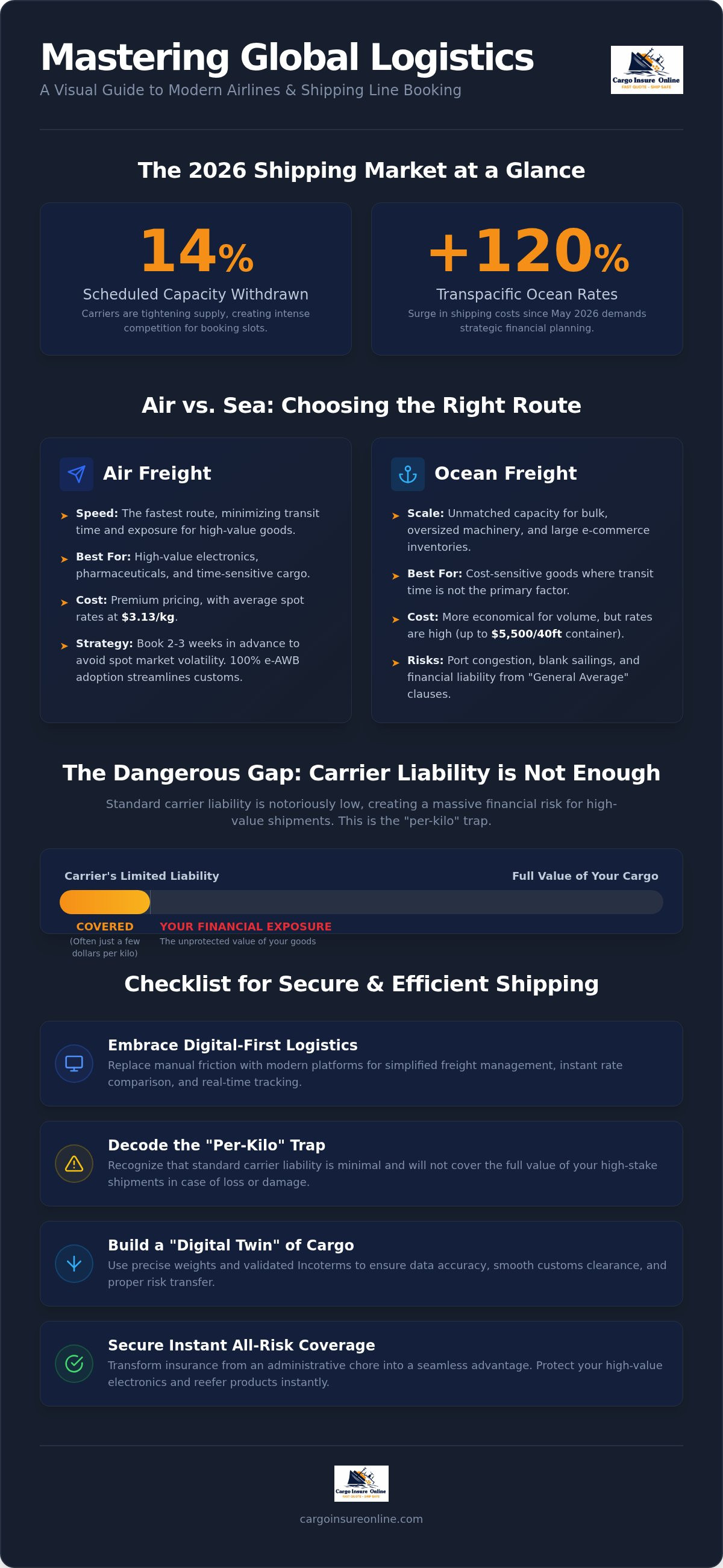
Carriers are currently withdrawing up to 14% of their scheduled capacity while transpacific ocean rates have surged 120% since May 2026. Securing an airlines/shipping line booking in this climate isn't just a logistics task; it's a high-stakes rescue mission for your bottom line. You're likely exhausted by clunky booking interfaces and the constant fear that one rough landing or turbulent sea will wreck your high-value cargo. Carrier liability limits are notoriously low, leaving your electronics or specialized equipment exposed when things go wrong.
It's true that traditional freight booking is a fragmented, bureaucratic headache. We agree that you shouldn't have to choose between speed and security. This guide promises to help you master the complexities of global logistics while shielding your high-value assets from the risks carriers refuse to cover. We'll preview the essential lead times for late 2026, navigate the July 1st EU customs regulation changes, and show you how to swap slow, manual insurance processes for instant, digital-first protection that actually moves at the speed of your business.
Key Takeaways
- Replace manual friction with digital-first logistics platforms that simplify how you manage and track global freight.
- Decode the "per-kilo" trap to understand why standard carrier liability rarely covers the full value of your high-stake shipments.
- Optimize your airlines/shipping line booking strategy by balancing speed, cost, and lead times for the volatile 2026 market.
- Build a "digital twin" of your cargo with precise weights and validated Incoterms to ensure risk transfers exactly when it should.
- Transform insurance from an administrative chore into a seamless advantage with instant, all-risk coverage for high-value electronics and reefer products.
Navigating the Airlines and Shipping Line Booking Ecosystem
Forget the days of manual spreadsheets and fragmented emails. That's the slow lane. Logistics in 2026 is an API-driven sprint where speed is the only currency that matters. Managing your airlines/shipping line booking now requires a digital-first mindset. You aren't just buying space on a vessel or a plane; you're securing a critical node in a high-speed, data-heavy freight transport ecosystem. While you can book directly with carriers to reclaim your margins, many professionals still utilize freight forwarders to navigate the complexities of global trade. The paperwork has shifted from physical stacks to digital assets. You'll manage the Air Waybill (AWB) for the skies and the Bill of Lading (BOL) for the oceans. In a market where carriers are pulling 14% of scheduled capacity, a confirmed slot isn't a guarantee of arrival. It's just the starting line.
Air Freight Booking Mechanics
IATA standards have finally pushed the industry toward 100% e-AWB adoption. It's faster, cleaner, and eliminates the data silos that used to stall shipments at customs. When you're securing uplift, the aircraft type is a strategic choice. Widebody planes provide the massive belly space needed for heavy, high-value electronics, while narrowbody jets handle regional, high-frequency hops. Real-time flight schedules allow you to pivot your supply chain in hours. This level of agility is non-negotiable when global air cargo spot rates are averaging $3.62 per kilogram as of July 2026. You don't have time to wait for a manual confirmation when the market moves this fast.
Ocean Freight and Shipping Line Dynamics
Ocean logistics is currently a high-stakes game of volume and strategic alliances. You must decide between Full Container Load (FCL) for maximum security or Less than Container Load (LCL) to keep your overhead low. With the Gemini Cooperation and other alliance shifts restructuring service networks this year, port congestion data is your most valuable weapon. Digital booking portals have largely replaced the traditional, slow-moving freight brokerage model. They offer a level of instant transparency and rate comparison that old-school phone calls simply can't match. You get the data you need to move fast, without the bureaucratic drag. It's about empowering your business with clarity and control over every container.
Air vs. Sea: Choosing the Right Route for Your Cargo
Selecting your route is a high-stakes calculation of velocity versus volume. It's not just about getting from A to B. It's about protecting your margin while meeting tightening international shipping regulations. In July 2026, the global average air cargo rate sits at $3.13 per kilogram. That's a premium price for a premium service. Meanwhile, ocean freight offers scale, but with container rates for a 40ft box from China to the U.S. West Coast hitting up to $5,500, the "cheap" alternative is becoming a major investment. Your airlines/shipping line booking decision must also account for the EU's Emissions Trading System (ETS) and the push for green logistics. Carbon footprints now carry a literal cost. You're no longer just choosing a carrier; you're choosing a compliance strategy.
High-Velocity Logistics: When Air Freight is Non-Negotiable
If you're moving high-value electronics, drones, or mobile phones, every hour in transit is an hour of exposure. Air freight minimizes the window for theft and damage. It's the backbone of the modern cold chain. It ensures temperature-sensitive reefer products and pharmaceuticals stay within strict tolerances. Because air cargo spot rates jumped 37% higher than last year, you can't afford a single loss. This is exactly why electronics shipping insurance is your most important booking add-on. It turns a risky flight into a guaranteed delivery. Secure your uplift at least two to three weeks in advance to avoid the spot market's volatility.
Scalable Global Trade: The Power of Shipping Lines
Ocean freight remains the champion of bulk. Whether it's oversized machinery or massive e-commerce restocks, shipping lines offer the cubic capacity air simply can't match. Smart e-commerce sellers use sea-to-door logistics to keep unit costs manageable, even with transpacific rates up 120% since mid-May. But the sea is unpredictable. Beyond the physical risks of port congestion and "blank sailings," you face legal risks like General Average. This is where all parties share the cost of a maritime loss. Robust sea freight insurance isn't optional. It's your shield against these ancient but very real maritime laws. Current lead times demand you book three to six weeks ahead to secure a container.
Before you finalize your next manifest, ensure your protection matches your ambition with instant cargo coverage that moves as fast as your supply chain. Don't let a booking decision become a liability.
The Dangerous Gap: Carrier Liability vs. All-Risk Cargo Insurance
Carriers move boxes. They don't move your business goals. When you finalize an airlines/shipping line booking, you're entering a legal contract that favors the carrier, not your high-value inventory. Most logistics managers fall into the "per-kilo" trap. They assume that because a carrier is responsible for the transit, they're also responsible for the full value of the goods. That's a dangerous assumption. Carrier liability is almost always calculated by weight, not by what the item is actually worth. If you're shipping lightweight, high-value electronics or drones, a standard payout will cover only a tiny fraction of your total loss. It's a financial cliff that most businesses don't see until they're already falling.
Claiming against a shipping line is an uphill battle. The burden of proof rests entirely on your shoulders. You have to prove the carrier was negligent, which is notoriously difficult once a container is sealed or a pallet is shrink-wrapped. Traditional carriers offer legal minimums; we offer total peace of mind. While carriers are focused on moving goods from port to port, Cargo Insure Online is focused on protecting your balance sheet from the unexpected. For a deeper look at your logistical choices, consult the International Trade Administration's Guide to Shipping Options to see how documentation and insurance intersect.
Decoding Carrier Liability Limits
Air freight is governed by the Montreal Convention. It sets a strict limit on what airlines owe you per kilogram of lost or damaged cargo. Sea freight follows the Hague-Visby Rules, which include 17 specific defenses carriers can use to avoid paying a cent. These include everything from "act of God" to "perils of the sea." Carrier liability is a legal minimum, not a comprehensive safety net. It exists to protect the carrier's solvency, not your profit margins.
All-Risk Insurance: The Professional Standard
All-risk insurance is the only way to bridge this gap. It covers theft, physical damage, and even catastrophic losses like a vessel sinking or a plane crash. When your high-tech inventory is fully insured, you stop worrying about carrier negligence and start focusing on growth. GAP insurance is the secret weapon here. It covers the difference between the carrier's meager payout and the actual replacement cost of your goods. In the high-speed world of 2026 logistics, this isn't just an add-on. It's a fundamental requirement for any serious airlines/shipping line booking strategy.
Actionable Checklist for International Shipping Bookings
Efficiency isn't an accident. It's the result of a rigorous, digital-first protocol. Before you finalize any airlines/shipping line booking, you must validate your Incoterms. Knowing exactly when risk transfers from the seller to the buyer is the difference between a minor delay and a total financial wipeout. If you're booking ocean freight in July 2026, remember that lead times are now three to six weeks. Don't guess; verify your obligations under CIF or FOB terms before you commit. It's about taking control of the variables you can see and protecting yourself against the ones you can't.
Next, prepare the "Digital Twin" of your cargo. This means providing hyper-accurate weights, dimensions, and descriptions. In the automated world of 2026 logistics, even a minor discrepancy can trigger a customs audit or an insurance dispute. For e-commerce sellers, this is even more critical. You must meet specific Amazon FBA cargo insurance requirements to avoid account suspensions or rejected shipments. Secure your instant insurance quote before the cargo even touches the warehouse floor. Waiting until it's in transit is a gamble you don't need to take.
Essential Documentation for Frictionless Booking
The Commercial Invoice is your primary defense. Accuracy here prevents customs bottlenecks and ensures that if a claim arises, the valuation is undisputed. Your Packing Lists need to be detail-oriented, especially for high-value electronics and temperature-sensitive reefer goods. Specify every serial number and sensor requirement. Finally, ensure your Electronic Export Information (EEI) is filed correctly to maintain global compliance. These aren't just forms. They're the data backbone of your shipment. When your documentation is flawless, the entire airlines/shipping line booking process moves at the speed of software.
Risk Assessment Before You Book
Look beyond the price tag. Evaluate route-specific risks like seasonal weather patterns, geopolitical stability, and current port efficiency. As of mid-July 2026, transpacific routes are seeing massive rate spikes and capacity withdrawals of up to 14%. Not all carriers are equal. Choose partners with proven handling records for specialized cargo like drones or fragile tech. Don't forget the "invisible" legs of the journey. Integrating trucking cargo insurance covers you for the first and last mile, where most damage actually occurs. Secure your strategy now with an instant digital insurance quote and move your cargo with total confidence.
Seamless Protection: Why Cargo Insure Online is the Final Step in Your Booking
You've secured your slot. You've validated your Incoterms. But your airlines/shipping line booking isn't complete until you've locked in protection that actually works. Traditional insurance is a slow-motion wreck of paperwork, manual quotes, and endless waiting. We've replaced that drag with vibrant, high-energy technology. Cargo Insure Online (CIO) is the disruptive force you need to match the high-speed tempo of 2026 logistics. We don't just provide policies; we provide the speed and clarity required to thrive in a volatile global market. Our system is built for the professional who demands results, not excuses.
Logistics in 2026 is too fast for the old way of doing things. You need a partner that understands the pressure of capacity constraints and rising rates. We've mastered the complexities of global trade and simplified them into a seamless digital journey. Whether you're managing a single high-value shipment or a complex global supply chain, our platform ensures your airlines/shipping line booking is backed by robust, all-risk coverage. It's about turning a perceived administrative chore into a positive, empowering experience that protects your balance sheet from the unexpected.
Digital-First Insurance for Modern Shippers
Traditional brokers love bureaucracy. We hate it. We've stripped away the friction to give you a transparent, action-oriented experience. This is insurance built for the e-commerce age, not the telegram age. Our platform gives you instant quotes that match the pace of modern air freight bookings. If you're a logistics provider, our branded cargo insurance platform lets you integrate these capabilities directly into your own workflow. It empowers you to offer instant value without the administrative burden. You get to focus on moving freight while our technology handles the risk. No more waiting for days for a quote that should take seconds.
Your Global Ally in Freight Protection
Whether your cargo is in the air, on the sea, or moving by truck, we provide a unified digital roof for your risk management. We specialize in the tech of tomorrow. From drones to the latest mobile phones and high-value devices, we understand that sophisticated inventory requires more than just a standard policy. Our team also masters the nuances of cold chain logistics, offering specialized reefer cargo insurance for temperature-sensitive goods. We aren't just a service provider; we're your sophisticated ally in a complex world. Stop settling for carrier liability that leaves you exposed. It's time to bridge the gap between carrier promises and actual cargo value. Move your business forward with a partner that values your time as much as your peace of mind. Get Your Instant Cargo Insurance Quote Today.
Master Your Global Logistics Strategy with Total Confidence
Success in 2026 logistics isn't just about moving boxes; it's about eliminating the financial gaps that carriers leave behind. You've seen how standard liability limits can leave your high-value electronics and specialized equipment dangerously exposed. Every airlines/shipping line booking you make is a high-stakes investment in your brand's future. Don't let outdated, manual insurance processes be the weak link in your supply chain. It's time to embrace a digital-first approach that prioritizes speed, clarity, and comprehensive protection.
We've stripped away the bureaucratic friction to give you global all-risk protection that activates in seconds. You deserve specialized coverage for drones and high-value tech that actually reflects their market value. Stop settling for the legal minimum and start demanding the professional standard. You have the tools and the checklist to navigate the current capacity constraints and rising rates. Now, take the final step to ensure your balance sheet is as secure as your cargo. Secure Your Next Booking with Instant Cargo Insurance. Your cargo is ready for takeoff, and we're here to make sure it lands safely.
Frequently Asked Questions
What is the difference between an airline booking and a freight forwarder booking?
An airline booking is a direct contract between your business and the carrier, while a freight forwarder acts as a middleman. Booking directly can help you reclaim margins if you have the digital tools to manage documentation. Forwarders simplify the process by aggregating volume and handling the e-AWB on your behalf, but they add a layer of cost to your logistics chain.
Does carrier liability cover the full value of my high-value electronics?
No, carrier liability almost never covers the full market value of electronics. Payouts are strictly calculated by weight, not by what the item is actually worth. If you lose a lightweight, high-value drone, the "per-kilo" payout from the airline will be a tiny fraction of your replacement cost. All-risk insurance is the only way to bridge this dangerous financial gap.
How do I book a shipment for temperature-sensitive reefer products?
You must explicitly select "reefer" service and provide exact temperature tolerances during your airlines/shipping line booking. Success depends on choosing carriers with proven cold chain infrastructure and real-time monitoring. Since mechanical failure can ruin your entire inventory, ensure your booking is backed by specialized reefer insurance that covers equipment breakdown and power loss during transit.
Is cargo insurance mandatory for airlines/shipping line bookings?
Cargo insurance isn't legally mandatory under international transport law, but it's a commercial necessity for most businesses. Most bank letters of credit and commercial contracts require proof of coverage before goods move. Operating without insurance means your business is personally responsible for any loss that exceeds the carrier's meager legal liability limits, which can be devastating for high-value shipments.
What are the specific insurance requirements for Amazon FBA shipments?
Amazon requires sellers to maintain active cargo insurance once they hit specific sales thresholds on the platform. Your policy must meet their minimum liability limits and provide global coverage that stays active until the goods are received at their fulfillment center. We provide specialized e-commerce insurance that satisfies these requirements instantly, ensuring your account stays compliant and your inventory remains protected during every leg of the journey.
How long does it take to get a cargo insurance quote with CIO?
It takes less than sixty seconds to receive a binding quote through our digital-first platform. We've eliminated the bureaucratic friction and slow email chains of traditional brokers to match the high-speed tempo of modern air freight. You can move from data entry to full protection in a single session, allowing you to secure your shipment before it even leaves the warehouse floor.
Can I insure my drones or specialized tech during air transit?
Yes, you can secure specialized protection for drones, mobile phones, and high-value devices during air transit. Standard airline liability is notoriously inadequate for tech-heavy shipments, but our policies are built specifically for these high-risk items. We cover physical damage, theft, and catastrophic loss, giving you the confidence to move the tech of tomorrow without worrying about the carrier's fine print.
What happens if my shipping line declares 'General Average'?
You'll be legally required to contribute to the cost of saving the vessel if the master declares General Average. This ancient maritime law means all cargo owners share the financial burden of an emergency, even if their own goods weren't damaged. Without sea freight insurance, the carrier can hold your cargo as collateral until you pay your share of the bond. Our policies handle these complex claims for you.


