
Your pre-alert email isn't a safety net. It's just a digital handshake that often leaves your cargo dangling over a liability abyss. You've done the work, hit send to pre-alert the overseas agent and now you're stuck in that nervous silence, hoping the destination team catches the baton without a fumble. It's a high-stakes game where a single manual data error or a missed update can trigger massive customs penalties under the 2026 ICS2 regulations. Moving data is easy, but moving risk is where most logistics professionals feel the heat.
We know the frustration of watching a shipment enter the "invisible gap" where liability feels blurred. This guide changes that. You're about to discover how to secure your cargo against the handover gap in real-time, turning a clunky manual process into a seamless digital workflow. We'll walk through the exact steps to achieve zero-gap insurance coverage and faster customs clearance. It's time to ensure your cargo is protected from the moment it leaves the port until it reaches the warehouse floor.
Key Takeaways
- Stop treating pre-alerts as a "set and forget" task; real cargo security begins the moment you hit send.
- Learn how to pre-alert the overseas agent and now master the "handover gap" using a high-speed, five-step post-alert checklist.
- Ditch the "invisible gap" by understanding why documentation is just data, while All-Risk insurance is your only true financial shield.
- Modernize your workflow by switching from clunky manual emails to lightning-fast, API-driven insurance integrations that secure coverage instantly.
What is a Pre-Alert and Why is the 'Now' Phase Critical?
A pre-alert isn't just a courtesy email. It's the digital pulse of your entire shipment. Think of it as a "heads up" sent by a freight forwarder to the destination agent before the cargo actually hits the dock. It tells the receiver that the goods are in motion. It provides the data they need to prepare for customs, drayage, and final delivery. Without it, your cargo is just a silent box taking up space. With it, your cargo becomes a high-priority asset moving through a choreographed system.
The problem? Many logistics teams treat the email as the finish line. You pre-alert the overseas agent and now the real work begins. This "now" phase is the critical window where legal responsibility shifts from the exporter to the importer. It's the "handover gap" where most claims happen. Data moves at light speed, but cargo is heavy and slow. If your data arrives but your risk isn't managed, you're flying blind. Traditional logistics relies on hope during this transition. Modern logistics relies on verified, insured handovers that leave nothing to chance.
The Anatomy of a Perfect Pre-Alert
A sloppy pre-alert is a liability. A perfect one is a masterclass in clarity. It must include the House Bill of Lading (HBL), Master Bill of Lading (MBL), Commercial Invoice, and the Packing List. These aren't just documents; they're the DNA of the shipment. You need to provide exact vessel or flight details and a firm ETA. Don't skip the "Remarks" section. This is where you flag special requirements for high-value electronics or reefer products. If the agent doesn't know the cargo needs temperature control or high-security handling, the handover will fail. Precision here prevents chaos later.
Why Timing is Everything in 2026
In 2026, customs systems like the EU's ICS2 and the U.S. ACE are API-first and unforgiving. They don't wait for human intervention. Air freight requires near-instant alerts because transit times are often shorter than the time it takes to process a manual email. If you pre-alert the overseas agent and now wait hours to confirm, you've already lost. Sea freight gives you more time, but late alerts are an open invitation for demurrage fees and terminal storage costs. Under current 2026 standards, missing an ISF 10+2 filing deadline for U.S. imports can result in penalties of up to $5,000 per violation. A pre-alert is the digital twin of the physical shipment. It must arrive first, it must be accurate, and it must be backed by a plan to move the risk as fast as the data.
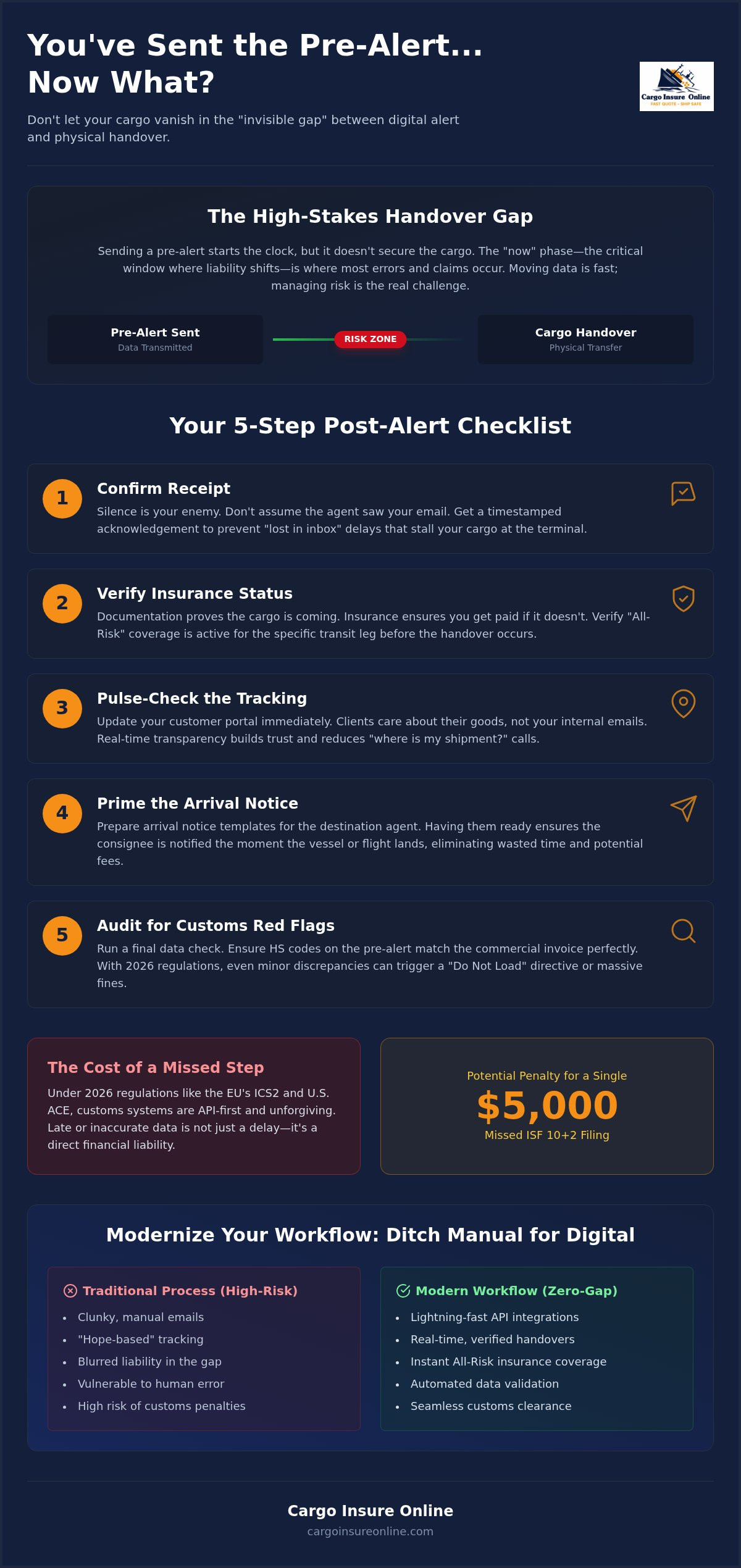
The 'And Now' Checklist: 5 Steps After You Pre-Alert the Overseas Agent
The "sent" folder is a dangerous place to find comfort. You hit send. The status says delivered. But in global logistics, delivered to an inbox isn't the same as delivered to the agent's workflow. You pre-alert the overseas agent and now you need to secure the perimeter. This is the active monitoring phase where you transform a passive data transfer into a bulletproof handover. Don't let your cargo sit in the "invisible gap" between ports. Follow this high-speed checklist to maintain control.
- Step 1: Confirm Receipt. Silence is your enemy. Don't assume the agent has seen your email. Get a timestamped acknowledgement to ensure no "lost in inbox" delays stall your cargo at the terminal.
- Step 2: Verify Insurance Status. Documentation tells the agent the cargo is coming. Insurance ensures you get paid if it doesn't. Verify that "All-Risk" coverage is active for this specific transit leg before the handover occurs.
- Step 3: Pulse-Check the Tracking. Update your customer portal immediately. Your client doesn't care about your internal emails; they care about their goods. Real-time transparency builds trust and reduces frantic "where is my stuff" phone calls.
- Step 4: Prime the Arrival Notice. Prepare your templates for the destination agent. Having these ready to fire ensures that as soon as the vessel or flight lands, the consignee is notified without a second of wasted time.
- Step 5: Audit for Customs Red Flags. Run a final data check. Ensure the HS codes on the pre-alert match the commercial invoice perfectly. In 2026, even a minor discrepancy can trigger a "Do Not Load" directive or a massive fine.
Confirming the Digital Handshake
A "sent" status is just a signal. While your freight management system might show a successfully transmitted alert, that doesn't mean the destination agent has verified the vessel details against their local schedule. Use automated tracking tools to bridge this communication gap. If an agent stays silent on a high-pressure route, pick up the phone. Automated reminders are great, but human verification is what prevents cargo from being abandoned on a dark pier. You pre-alert the overseas agent and now you must demand the digital handshake that confirms they are ready for the baton.
Pre-Clearing Customs: The Pro Move
Why wait for the cargo to land? Leveraging your pre-alert data for early customs filing is the ultimate efficiency hack. By submitting data to agencies like U.S. Customs or the EU's ICS2 system 24 hours before arrival, you drastically reduce port dwell time. This pro move ensures your Incoterms align perfectly with the responsibilities outlined in your alert. Securing your cargo shouldn't be a hurdle. Getting instant sea freight insurance ensures your risk is covered before the ship even docks, making the customs process smoother and your liability clearer.
The Invisible Gap: Documentation vs. All-Risk Insurance
A pre-alert is a promise. Insurance is a guarantee. When you pre-alert the overseas agent and now assume the cargo is safe because the paperwork is in order, you're falling into the "invisible gap." Documentation tells the agent the cargo is coming. It prepares the dock. It alerts customs. But it does absolutely nothing if a crane operator fumbles a container or a storm hits the mid-Atlantic. In global trade, data is your map, but insurance is your shield.
The "handover gap" is where the most damage occurs. It's that volatile window where responsibility shifts between parties, often at busy terminals or during cross-docking. If you rely solely on standard maritime law, you're leaving your balance sheet exposed. You need more than just a digital trail; you need financial protection that moves as fast as your shipments. Relying on hope isn't a strategy. Securing your cargo against the physical reality of global transit is.
Liability vs. All-Risk Protection
Don't confuse carrier liability with insurance. It's a common mistake that costs businesses millions every year. Carriers operate under restrictive international treaties and "Per-Kilo" rules, paying out based on weight rather than the actual value of your goods. If your high-value cargo is lost, you'll likely receive pennies on the dollar. Understanding the difference between Carrier Liability vs Cargo Insurance is vital for your survival. Even worse, "General Average" rules mean you could be forced to pay for a ship's salvage even if your own cargo arrived untouched. All-Risk insurance is the only way to ensure 100% peace of mind, dismissing these antiquated risks with modern, total-value coverage.
Protecting Specialized Cargo During Handover
Standard coverage often fails when things get technical. For tech-heavy shipments, electronics shipping insurance is a non-negotiable requirement to cover theft, static damage, or handling errors that standard policies ignore. The stakes are equally high for the cold chain. In reefer cargo insurance, the handover is the ultimate stress test. A single hour without power or a missed temperature log during the transition can ruin an entire shipment. When you pre-alert the overseas agent and now move into the physical transfer, having specialized, digital-first coverage ensures that a technical glitch doesn't become a total loss.
Modernizing the Workflow: Digital Tools and Instant Coverage
Legacy logistics is a graveyard of manual spreadsheets and frantic email threads. It's slow. It's error-prone. It's exhausting. But it doesn't have to be this way. The 2026 shipping environment is API-first. If you're still typing out pre-alerts manually, you're already behind. You pre-alert the overseas agent and now you need that data to trigger your insurance coverage instantly. No waiting. No re-keying. Just pure, unadulterated speed. Digital tools have turned a multi-step chore into a single-click reality.
Integrating insurance directly into your Freight Management System (FMS) is the ultimate power move. It eliminates the "invisible gap" we discussed earlier by ensuring that as soon as a shipment is created, it's protected. You pre-alert the overseas agent and now the platform handles the risk management while you focus on scaling your operations. This isn't just about convenience; it's about survival in a market where margins are thin and expectations are sky-high. Modern logistics demands 2026 technology, not 1990s paperwork.
API Integration: The Future of Pre-Alerts
Stop the double data entry madness. When your systems talk to each other, errors vanish. API-driven pre-alerts allow you to push data from your FMS straight to insurance providers and overseas agents simultaneously. This is how branded cargo insurance platforms empower forwarders to act like tech giants. You get real-time visibility and the absolute certainty that your cargo is covered the exact second the alert is sent. It's a seamless loop of data and protection that keeps your business moving forward without the friction of manual certificates.
Reducing Friction in the Global Supply Chain
Automation provides a level of psychological relief that manual systems can't touch. When you automate the "Now" phase, you stop being a paper-pusher and start being a strategic risk manager. You're no longer chasing agents for confirmation or double-checking if a policy was issued. The system does the heavy lifting. This digital-first approach transforms the high-pressure handover into a routine, frictionless event. It empowers your team to handle higher volumes with zero extra stress. It's time to work smarter, not harder. You can get an instant cargo insurance quote today and see how fast your workflow can truly be.
Cargo Insure Online: Your Partner After the Pre-Alert
Logistics doesn't sleep, and neither should your protection. You've mastered the documentation. You've optimized the timing. But the most sophisticated workflow in the world still fails if your insurance partner is stuck in the era of fax machines and 48-hour turnaround times. We don't just provide a policy; we accelerate your entire global operation. You pre-alert the overseas agent and now you need a partner that operates at the same high-frequency speed as your data. Cargo Insure Online is built for the modern forwarder who demands instant results and zero excuses.
Our tech-first approach is the perfect match for the 2026 supply chain. We've stripped away the bureaucracy to focus on what matters: speed and clarity. Whether you're moving high-volume retail goods or specialized components, our platform mirrors the rhythm of your business. We provide custom solutions for the high-stakes sectors that traditional insurers often shy away from. From high-value electronics and sensitive reefer products to the rapid-fire world of e-commerce, we ensure your risk is managed before the cargo even reaches the destination terminal.
Zero Friction, Total Protection
Stop waiting for quotes that should take seconds. Our digital engine delivers sea freight insurance and air freight coverage in the time it takes to send an email. We've designed every aspect of our service to remove friction from your day. This includes a claims process built for the digital age. No endless paperwork. No opaque timelines. Just a transparent, efficient system that respects your time. It's why top-tier forwarders have ditched the legacy providers and made the switch to a partner that values momentum as much as they do.
Ready to Secure Your Next Shipment?
The "invisible gap" is only a threat if you let it be. Don't let your pre-alert be the final action you take. Security requires a proactive stance. You pre-alert the overseas agent and now you have the opportunity to lock in total protection before the handover happens. Transition from a passive participant to a dominant risk manager. Empower your team with tools that actually work. Secure your cargo, protect your margins, and move forward with the confidence that only a digital-first ally can provide. Your cargo is moving fast. Your insurance should move faster.
Protect your shipment with an instant quote from Cargo Insure Online.
Own Your Risk and Accelerate Your Growth
The era of "hope and pray" logistics is over. You've learned that a pre-alert is merely the digital twin of your cargo; it doesn't pay the bills if a container is lost at sea. True security means closing the handover gap with All-Risk protection that matches the speed of your data. It's time to pre-alert the overseas agent and now secure the physical reality of your shipment before it even reaches the dock. Don't settle for carrier liability that pays pennies when you can have total value protection.
Cargo Insure Online is your high-speed ally in this journey. We provide instant digital quotes and specialized coverage for high-value tech with a global reach across sea, air, and road. Stop letting manual gaps dictate your liability. Start using technology that protects your margins as fiercely as you do. You've optimized your documentation; now optimize your peace of mind.
Stop the risk and secure your cargo now with Cargo Insure Online
The global supply chain is fast, but you're faster. Let's get your next shipment covered today and keep your business moving at the speed of 2026.
Frequently Asked Questions
What exactly should be included in a pre-alert to an overseas agent?
A perfect pre-alert must include the House Bill of Lading, Master Bill of Lading, Commercial Invoice, and Packing List. These documents provide the destination agent with the data required for customs prep and terminal handling. You should also include specific flight or vessel details, the ETA, and any handling requirements for specialized goods like electronics or reefer cargo. Precision here prevents terminal chaos.
Does a pre-alert transfer legal liability to the destination agent?
No, a pre-alert is a communication tool, not a legal transfer of liability. While it informs the agent of their upcoming responsibilities, the risk typically remains with the shipper or exporter until a physical handover occurs or Incoterms dictate otherwise. This is why you must pre-alert the overseas agent and now ensure your insurance coverage bridges the gap between these parties. Documentation alone won't pay a claim.
How soon before arrival should I pre-alert the overseas agent?
Timing depends on the mode of transport, but sooner is always better. For air freight, send the alert as soon as the flight departs to accommodate high transit speeds. For sea freight, aim for at least 3 to 5 days before arrival to allow for ISF filings or other customs requirements. Under 2026 regulations like ICS2, late data can trigger immediate "Do Not Load" directives or heavy fines.
Is carrier liability enough once the pre-alert is sent?
Absolutely not. Carrier liability is notoriously limited and often pays out based on weight rather than the cargo's actual value. If your high-value electronics are damaged, you might receive only pennies on the dollar. Only an All-Risk insurance policy provides the full financial protection needed to recover the actual cost of lost or damaged goods. Don't let a "per-kilo" rule gut your profit margins.
What happens if the overseas agent doesn't acknowledge the pre-alert?
Silence creates a massive operational risk that you cannot ignore. If an agent fails to acknowledge the alert, follow up immediately via phone or a high-priority digital message. Without a confirmed receipt, your cargo could sit at the terminal, incurring expensive demurrage fees or missing crucial customs deadlines. A "sent" email is just a signal; an "acknowledged" alert is a completed handshake.
Can I buy cargo insurance after I've already sent the pre-alert?
Yes, you can secure coverage as long as the transit hasn't ended and no loss has occurred. Many forwarders pre-alert the overseas agent and now use digital platforms to grab an instant quote for the remaining leg of the journey. However, the best practice is to have insurance active before the cargo moves. This ensures there are zero gaps in protection during the high-risk handover phase.
How do digital pre-alerts differ from traditional email alerts?
Digital pre-alerts are API-driven and integrate directly into your Freight Management System. Unlike traditional emails, which are static and prone to being lost in an inbox, digital alerts provide real-time visibility and automated status updates. They eliminate manual data entry errors and allow you to trigger insurance certificates the moment the shipment data is created. It's the difference between a manual chore and an automated workflow.
What are the most common mistakes in the pre-alert process?
The biggest blunders are missing documents, incorrect HS codes, and failing to confirm receipt. Even a minor typo in the manifest can lead to a $5,000 fine for non-compliance with U.S. customs filings. Another common error is assuming the pre-alert covers your financial risk. This leads to businesses being underinsured during the most dangerous phase of transport. Avoid these traps by using digital tools that audit your data.


