
Did you know that nearly 35% of goods transported by land are currently underinsured? When a shipment worth over $270,000 vanishes, relying on standard carrier liability that pays out pennies on the dollar isn't just a risk. It's a business-ending catastrophe. You want to provide total protection, but the old way of doing things is broken. Manual booking is slow. It kills your margins and leaves you terrified of the legal fallout if a claim is denied. It's time for a modern approach to how logistics pros INSURE THE CARGO on behalf of their customers.
We agree that insurance shouldn't be an administrative anchor dragging down your operations. This guide will show you how to transform cargo protection from a liability into a digital-first competitive advantage. You'll discover how to protect your clients, eliminate coverage gaps, and unlock new revenue streams by offering instant, digital insurance. We're moving past the era of slow, bureaucratic paperwork and into the future of white-label solutions that reduce documentation errors by 25% and build client loyalty with every load.
Key Takeaways
- Stop trusting "per-kilo" carrier liability to protect your reputation; it is a legal safety net for carriers, not a recovery plan for your clients.
- Master the modern framework to INSURE THE CARGO on behalf of their customers using digital tools that eliminate legal friction and manual errors.
- Unlock a fresh revenue stream by evolving from a logistics provider into a "one-stop-shop" offering seamless Insurance-as-a-Service.
- Replace slow, margin-killing manual bookings with high-speed API integrations that automate the entire insurance trigger instantly.
- Follow a proven 5-step audit to identify liability gaps and choose a technology-driven partner that scales with your global operations.
The Liability Gap: Why You Must Insure Cargo on Behalf of Your Customers
Carrier liability is a shield for the carrier, not a safety net for your client. Many logistics providers mistakenly believe that standard carrier terms offer enough protection. They don't. In reality, carrier liability is a limited legal framework designed to minimize the transporter's financial exposure. It is not a substitute for comprehensive coverage. When you choose to INSURE THE CARGO on behalf of their customers, you are closing a massive financial hole that most shippers don't even know exists until it's too late.
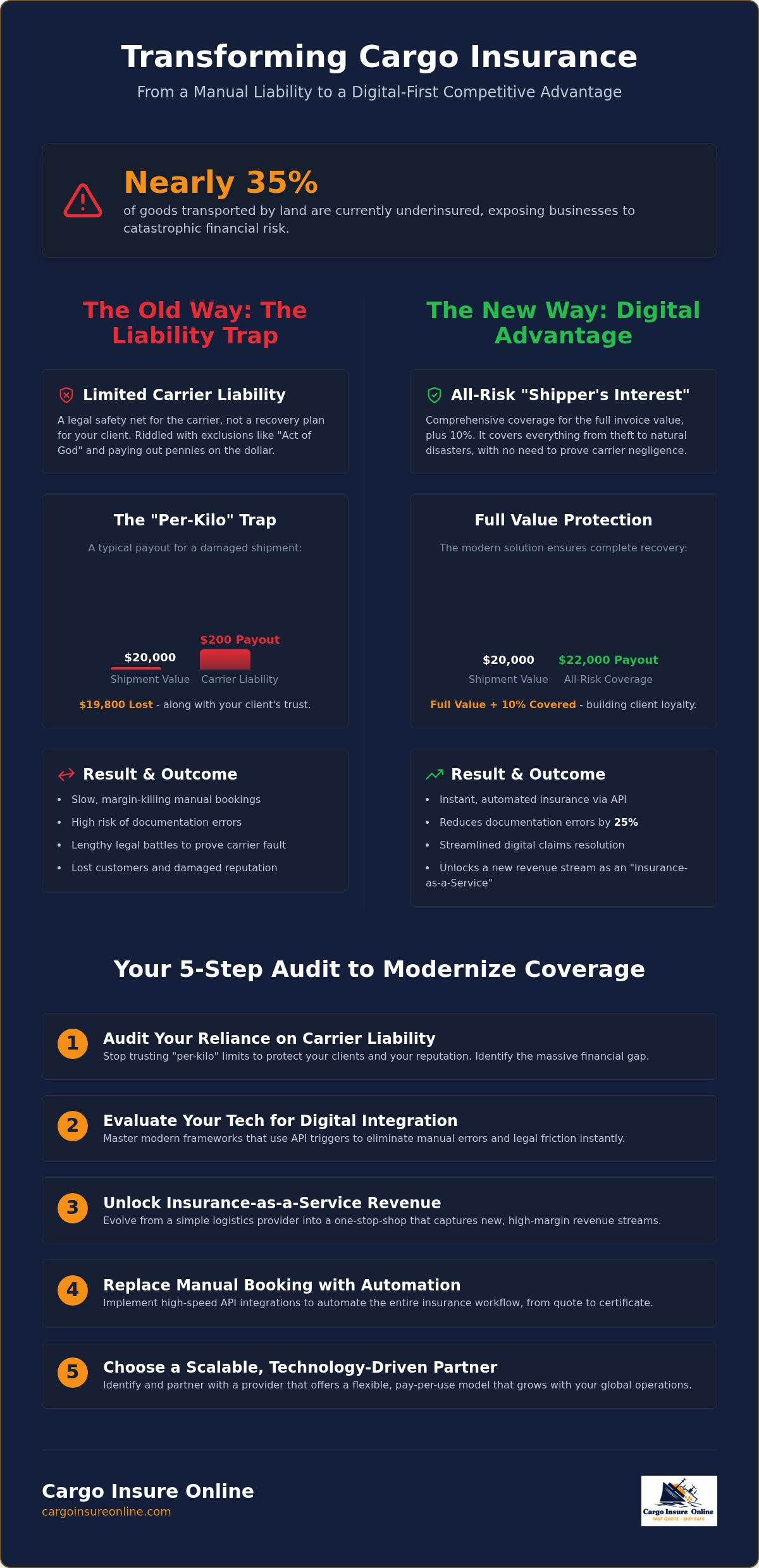
The "per-kilo" trap is the most dangerous part of this gap. Imagine a shipment of high-value electronics worth $20,000. If that cargo is damaged under standard LTL terms, the carrier might only be liable for $0.50 per pound. A 400-pound pallet could result in a measly $200 payout. Your customer loses $19,800, and you likely lose that customer forever. To understand the roots of these protections, one must look at the history of Marine insurance, which has evolved from ancient risk-sharing into the high-speed digital coverage we use today. Shipper's Interest insurance is the only way to ensure the full invoice value is protected, regardless of weight or carrier limits.
Carrier Liability vs. All-Risk Coverage
Standard liability is riddled with "Act of God" exclusions. If a hurricane sinks a ship or a tornado flips a truck, the carrier usually owes nothing. Under the Montreal Convention for air freight, liability is capped at roughly 22 SDR per kilogram. For sea freight, the Hague-Visby rules limit payouts to 2 SDR per kilogram or 666.67 SDR per package. These numbers are tiny compared to the actual value of modern freight. All-Risk coverage dismisses these hurdles. It pays out the full invoice value plus 10%, covering everything from theft to natural disasters without the need to prove carrier negligence.
The Legal Mechanics of 'On Behalf Of'
You don't need to be an insurance agent to offer better protection. Logistics forwarders act as intermediaries, leveraging "Open Policies" to provide coverage. When freight pros INSURE THE CARGO on behalf of their customers, they are simply facilitating a Shipper's Interest policy that attaches directly to the goods. It's vital to update your Terms and Conditions to reflect this service. By doing so, you bypass the long, painful process of proving carrier fault. Claims are settled based on the fact that damage occurred, not who was to blame. This turns a six-month legal battle into a streamlined digital resolution. It's fast, it's transparent, and it's the modern standard for global trade.
Insurance-as-a-Service: Turning Protection into a Revenue Stream
Stop viewing insurance as a tedious administrative chore. It is a profit center waiting to be unlocked. Most forwarders leave money on the table because they treat coverage as an afterthought. They shouldn't. By offering Insurance-as-a-Service, you turn a necessary protection into a consistent revenue stream. You aren't just moving boxes. You are providing a comprehensive, one-stop-shop logistics solution that captures margins your competitors are missing. When you INSURE THE CARGO on behalf of their customers, you build a fortress of trust around your brand.
This model does more than boost your bottom line. It slashes your professional liability. If a shipment is lost and the customer has no coverage, they look to you for compensation. That leads to friction, legal threats, and lost accounts. Providing a digital certificate of insurance at the point of booking eliminates this risk instantly. While every carrier must meet basic FMCSA insurance requirements, those filings exist to protect the public and the carrier. They do nothing for your client's specific cargo value. Offering your own solution ensures the shipper is whole, and your reputation remains intact.
The Pay-Per-Use Advantage
Forget the old world of massive upfront premiums and rigid annual commitments. Modern insurance is elastic. With a pay-per-use model, you only pay for the coverage you actually use. This allows you to integrate insurance costs directly into your freight quotes without hurting your cash flow. It scales effortlessly. Whether you ship ten containers or ten thousand, the system adjusts to your volume. This frictionless approach means you can start generating revenue from day one without any financial barriers to entry. It is efficient. It is smart. It is the future of logistics.
High-Value Niche Opportunities
Standard policies often fail when it comes to sophisticated freight. This is your chance to shine. High-value markets like electronics shipping insurance require specialized terms that generic carriers simply cannot provide. By offering tailored protection for drones, mobile phones, and enterprise hardware, you position yourself as a high-performing specialist. These niches carry higher margins and attract premium clients who value security over the lowest price. Transitioning to digital cargo insurance solutions allows you to capture this business with zero manual effort, turning high-risk shipments into high-reward opportunities.
Digital Integration: API vs. Manual Insurance Booking
Manual insurance booking is a relic of a slower era. It is a bottleneck that kills your momentum and eats your margins. If your team is still downloading PDFs, filling out forms, and waiting for email confirmations, you aren't just wasting time. You are increasing the risk of human error. Digital platforms can reduce documentation errors by over 25% compared to these manual methods. Logistics professionals must use every tool available to protect against cargo risks, especially as sophisticated theft and identity fraud continue to rise. It's time to stop the paperwork and start the automation.
Frictionless logistics requires a digital trigger. When you choose to INSURE THE CARGO on behalf of their customers, the process should be as fast as the booking itself. Digital integration replaces the "request and wait" cycle with instant confirmation. This isn't just about speed; it's about accuracy. By pulling data directly from your shipment records, you eliminate the typos that lead to denied claims. You gain a high-speed, transparent workflow that keeps your operations moving at the pace of global trade. No more bottlenecks. No more guesswork.
The Power of White-Label Solutions
Your brand is your most valuable asset. Why send your customers to a third-party site to secure their freight? Launching a branded cargo insurance platform allows you to own the customer relationship from quote to claim. It keeps your brand front-and-center, increasing customer retention and building professional authority. You can customize the user journey to match your existing logistics portal, creating a seamless experience that feels like a natural extension of your services. This turns a standard administrative step into a powerful loyalty tool.
API Integration for High-Volume Forwarders
For high-volume forwarders, API integration is the ultimate force multiplier. By connecting your Transport Management System (TMS) directly to an insurance engine, you can INSURE THE CARGO on behalf of their customers without lifting a finger. Quotes are generated the moment a shipment is booked. Coverage is bound instantly. Even claims filing becomes a streamlined, data-driven process. This reduces the administrative burden on your team and ensures that not a single shipment slips through the cracks. It is the most efficient way to scale your insurance offering alongside your shipping volume, turning complex logistics into a frictionless, automated success story.
5 Steps to Start Insuring Cargo for Your Clients Today
Stop waiting for a massive loss to force your hand. Transitioning your business model is simpler than you think. You don't need a legacy insurance broker's permission to modernize. By following a structured roadmap, you can begin to INSURE THE CARGO on behalf of their customers with confidence and clarity. This isn't just about protection. It's about professional evolution. It's about moving from a simple transporter to a high-value logistics partner. The process is fast. It's transparent. It's the modern standard for global trade.
Your first move is to audit your exposure. Look at your last 12 months of claims. Where did carrier liability leave your clients hanging? Once you see the gaps, you can select a digital-first partner. You need a technology engine, not a file cabinet. Update your service agreements next. Make insurance an "opt-out" or "opt-in" standard on every quote. Train your sales team to explain the trap of limited liability. Finally, launch a pilot program on a single high-volume route to ensure your new digital workflow is frictionless.
Auditing Your Risk Profile
Every commodity carries a different threat level. You must identify which cargo types need immediate intervention. For example, specialized reefer cargo insurance is critical for cold chain protection. A single power failure can destroy a high-value shipment in hours. Review your loss history to see where carrier payouts fell short. Gather this data. It is the fuel for accurate, instant quotes. Knowing your risks allows you to protect your clients before the first mile begins.
Choosing the Right Partner
Don't settle for a local broker with limited reach. You need a partner with global, multi-modal capabilities across Air, Sea, and Trucking. Prioritize speed and digital integration. A partner with a fast, digital claims process will save your reputation when things go wrong. Evaluate their tech stack. Can they connect to your TMS? Do they offer white-labeling? When you choose to INSURE THE CARGO on behalf of their customers, the right partner acts as a silent engine for your growth. Ready to lead the market? You can start your digital cargo insurance journey today and turn liability into a competitive edge.
Cargo Insure Online: The Engine for Your Insurance Success
Stop wrestling with the bureaucratic giants of the past. They are slow. They are rigid. They don't understand the high-velocity nature of your daily operations. Cargo Insure Online (CIO) is the modern alternative designed specifically for the digital era of logistics. We provide the sophisticated technology that allows you to INSURE THE CARGO on behalf of their customers without the administrative weight that usually drags down your margins. Whether you are navigating the complexities of the trucking cargo insurance market or securing global air freight, we act as the silent engine behind your success.
The 2026 economy demands more than just basic protection. It requires a partner that understands specialized risks like drones, enterprise mobile devices, and high-value tech. We've mastered these niches so you don't have to. Our platform ensures zero-friction claims, which is the ultimate tool for maintaining customer loyalty when the unexpected happens. You aren't just selling a policy; you're providing a promise of resilience. By leveraging our digital-first approach, you turn every shipment into an opportunity to prove your value as a sophisticated logistics ally.
Our Technology, Your Brand
Small forwarders shouldn't have to look small. Our white-label solutions empower you to present a world-class insurance engine under your own brand. It is about building professional authority and increasing retention. For enterprise logistics players, our API integration is the gold standard for simplicity. It connects your existing TMS to our coverage engine instantly. We handle the global regulatory shifts and continuous software updates so your team can stay focused on moving freight. It is your brand, powered by our intelligence. This creates a vertical, fast-moving experience that respects your time and your clients' needs.
Get Started in Minutes
Forget the traditional insurance experience that relies on manual entry and endless email chains. No long forms that take hours to complete. No waiting days for a quote that might be outdated by the time it arrives. No bureaucratic hurdles that kill your momentum. Just instant, digital coverage that works as fast as you do. We've removed the friction so you can focus on scaling your operations. It's time to transform your logistics business into a modern, revenue-generating powerhouse. You can scale your logistics business with frictionless insurance by requesting your first demo today. The future of cargo protection is here. It is digital, it is fast, and it is ready for you.
Lead the Future of Frictionless Logistics
The era of bureaucratic delays and per-kilo traps is over. You've seen how easy it is to bridge the liability gap and turn cargo protection into a high-margin profit center. It's time to evolve. When you choose to INSURE THE CARGO on behalf of their customers, you eliminate friction and build lasting loyalty. You aren't just moving freight; you're providing peace of mind at the speed of light.
We provide the engine while you grow your brand. With specialized high-value electronics coverage and instant digital quotes, you can offer a premium service without the administrative burden. Our seamless API and white-label integration make the transition effortless. Don't wait for the next catastrophe to reveal your risks. Start insuring your customers today with Cargo Insure Online and take your place at the forefront of modern trade. The future is digital, and it's yours for the taking.
Frequently Asked Questions
Can a freight forwarder legally insure cargo on behalf of a customer?
Yes, it is perfectly legal. Freight forwarders operate as intermediaries by leveraging open policies to INSURE THE CARGO on behalf of their customers. This allows you to offer Shipper's Interest coverage without being a licensed insurance agent yourself. It's a standard industry practice that protects both your client and your professional reputation by facilitating a direct policy between the insurer and the shipper.
What is the difference between freight forwarder liability and cargo insurance?
Liability is a limited legal protection for the carrier; insurance is a full-value safety net for the cargo owner. Carrier liability usually pays out based on weight, which can be as low as $0.50 per pound for LTL shipments. Cargo insurance pays the full invoice value regardless of weight or who was at fault. It's the difference between a catastrophic financial loss and a total recovery.
How much does it cost to add cargo insurance to a shipment?
Industry averages for per-shipment coverage typically range from 0.1% to 2% of the declared cargo value. For a $100,000 shipment, this might cost between $100 and $500 depending on the commodity, route, and risk factors. It's a tiny fraction of the potential loss. Digital platforms provide these quotes instantly so you can build them directly into your freight quotes without slowing down your operations.
What happens if a customer refuses insurance and the cargo is damaged?
The customer is stuck with the carrier's weight-based liability limits. If a high-value electronics shipment is destroyed, they might only receive a few hundred dollars for a $20,000 loss. This usually leads to a broken business relationship and legal threats against the forwarder. Offering insurance at the point of booking prevents this nightmare scenario and protects your brand from the fallout of a denied claim.
Does 'All-Risk' cargo insurance really cover everything?
All-Risk coverage protects against the widest range of physical loss or damage from external causes. It isn't a blanket for every possible scenario, as it typically excludes things like improper packing, inherent vice, or intentional misconduct. However, it far exceeds standard liability by covering theft, "Acts of God," and transit accidents without needing to prove carrier negligence. It's the most comprehensive protection available in the 2026 logistics market.
How do I file a cargo insurance claim for a customer?
Filing is a streamlined, digital process when using modern platforms. You simply upload the commercial invoice, the bill of lading, and photos of the damage through your provider's portal or API. Because Shipper's Interest policies don't require proving carrier fault, the timeline for a payout is significantly faster than traditional liability claims. This efficiency keeps your customers happy even when things go wrong.
Is an insurance license required to offer white-label insurance?
You typically don't need a full insurance license to offer white-label solutions as a logistics provider. By partnering with a digital-first insurer, you are facilitating a Shipper's Interest policy that attaches to the goods. You act as the tech-savvy intermediary, providing your clients with a seamless, branded experience while the underlying insurer carries the risk. It's a frictionless way to add a new revenue stream to your business.
How does Incoterms affect who should buy the cargo insurance?
Incoterms like CIF and CIP mandate that the seller provides insurance, but other terms leave it up to the buyer. Regardless of the specific Incoterm used, forwarders can simplify the process to INSURE THE CARGO on behalf of their customers. This ensures the goods are protected from door to door. It eliminates any confusion about who is responsible for a loss during transit and provides a superior customer experience.


